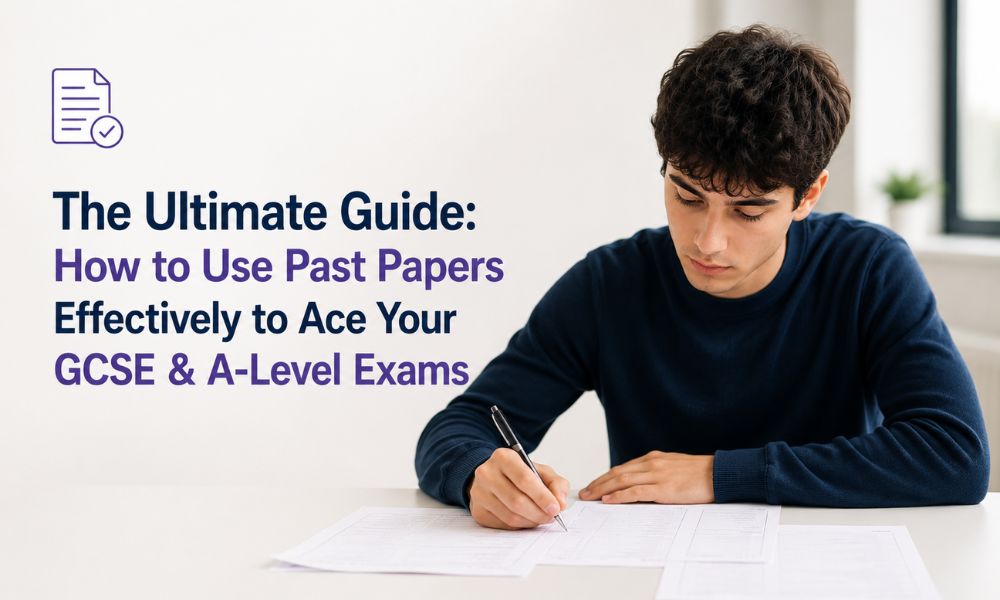
As exam season rapidly approaches, students up and down the UK find themselves drowning in a sea of colourful highlighters, perfectly formatted revision timetables, and thick textbooks. However, if you speak to any top-performing student or seasoned examiner, they will all point to one single revision technique that stands head and shoulders above the rest: practising with past papers.
At Merit Study Resources, we provide students, parents, and schools with an extensive database of past papers, revision notes, and worksheets. But having access to thousands of past papers is only half the battle. Knowing how to use them effectively is what truly transforms a mediocre grade into a phenomenal one.
In this comprehensive guide, we will explore the science behind past papers, outline a step-by-step method for using them, and explain how to avoid the common pitfalls that trap many students.
It is easy to fall into the trap of "passive revision." This involves reading through your class notes, re-reading textbook chapters, or watching educational videos. While these methods are useful for initial understanding, they do not test your ability to retrieve information under pressure.
Past papers force you into active recall. This is a cognitive process that strengthens the neural pathways in your brain, making the information significantly easier to remember on the actual exam day. Furthermore, using past papers helps you:
-
Understand the Exam Format: You become intimately familiar with how the paper is structured, the types of questions asked, and the specific wording examiners use.
-
Improve Time Management: Exams are a race against the clock. Practising helps you gauge exactly how long to spend on a 2-mark question versus a 10-mark essay.
-
Identify Knowledge Gaps: A past paper acts as a diagnostic test. It violently exposes the topics you think you know, but actually don't.
Step-by-Step: How to Use Past Papers for Maximum Impact
If you want to achieve the highest possible grades in your GCSEs, IGCSEs, or A-Levels, simply reading through a past paper is not enough. You must implement a highly structured approach.
Step 1: Start Early (But Not Too Early)
Do not wait until the week before your exam to look at a past paper. You should integrate them into your revision schedule a few months in advance. However, do not attempt a full paper until you have covered at least 70% of the syllabus. If you try a paper too early, you will encounter topics you have not been taught, which can severely damage your confidence.
Step 2: Access High-Quality Resources
Finding the right papers for your specific exam board (AQA, Edexcel, OCR, Cambridge) can be incredibly tedious. This is where Merit Study Resources comes in.
We offer an easily searchable, highly organised database of free GCSE, IGCSE, and A-Level past papers. Instead of scouring the internet and navigating confusing exam board websites, you can find everything you need in one secure place.
Step 3: Phase One - The 'Open Book' Approach
When you tackle your very first past paper, do not worry about time limits. Treat it as a learning exercise. Keep your textbooks, revision notes, and our expert-crafted worksheets open next to you. If you get stuck on a question, actively look up the answer. This phase is about learning how to apply your knowledge to specific exam questions.
Step 4: Phase Two - Strict Exam Conditions
As the actual exam draws closer, you must strip away the safety nets. Print the paper out (reading from a screen does not replicate the exam hall experience). Clear your desk, set a strict timer, turn off your mobile phone, and sit the paper in absolute silence.
This phase builds your mental stamina. A 2.5-hour A-Level paper is exhausting; you need to train your brain to remain intensely focused for the entire duration.
Step 5: The Magic of the Mark Scheme
Sitting the past paper is only 50% of the work. The real magic happens when you mark it. Examiners are notoriously pedantic; they look for very specific keywords and phrases.
Download the official mark scheme and mark your paper brutally. If you missed a specific keyword required by the mark scheme, mark it wrong. This teaches you to "think like an examiner." You will quickly notice patterns in what the examiners reward and what they penalise.
Step 6: Targeted Intervention
Once you have marked your paper, categorise your mistakes:
-
Silly mistakes: (e.g., misreading the question or a simple calculator error).
-
Time management issues: (e.g., rushing the final essay).
-
Knowledge gaps: (e.g., completely forgetting the process of cell mitosis).
For your knowledge gaps, you must implement targeted intervention. Do not just re-read the textbook. Use our specialised Classwork and Homework Booklets to drill those specific weak areas until they become your strengths.
Common Mistakes to Avoid
Even with the best intentions, students often misuse past papers. Ensure you absolutely avoid these common traps:
-
Memorising Mark Schemes: Some students try to memorise the exact answers from mark schemes. Exam boards constantly rewrite questions to catch out students who do this. You must understand the underlying concept, not just the specific answer.
-
Ignoring the Examiner’s Report: Alongside the mark scheme, exam boards publish an 'Examiner's Report'. This document outlines exactly where students globally struggled in that specific paper. Reading this is like having a cheat sheet of common traps to avoid.
-
Only Doing Recent Papers: While the most recent papers are the most accurate reflection of the current syllabus, older papers are still a goldmine of practice questions. Just cross-reference them with your current specification to ensure the topics are still relevant.
Unlocking Your Full Potential with Merit Study Resources
While we provide thousands of free past papers to get you started, serious students and proactive schools often require a more comprehensive toolkit.
At Merit Study Resources, we offer incredibly affordable subscription packages tailored for both individual students and entire schools.
-
For Students: Our premium access unlocks exclusive revision notes, highly targeted worksheet tests, and comprehensive classwork booklets. These resources are meticulously designed to bridge the gap between struggling with a past paper and mastering the final exam.
-
For Schools and Teachers: We offer multi-user packages that allow teachers to download extensive homework booklets and assessment materials, saving hundreds of hours of lesson planning and marking time.
Final Thoughts
The secret to exam success is no longer a secret. It is a combination of hard work, strategic revision, and relentless practice using past papers. By understanding the demands of the examiner and familiarising yourself with the paper's format, you strip away the anxiety of the unknown.
Do not leave your academic future to chance. Head over to Merit Study Resources today, download your first past paper, and begin your journey towards exam excellence.
Ready to try it? Every paper in the library comes with its mark scheme and a
worked solution, so you can practise without hunting for files.
Find past papers