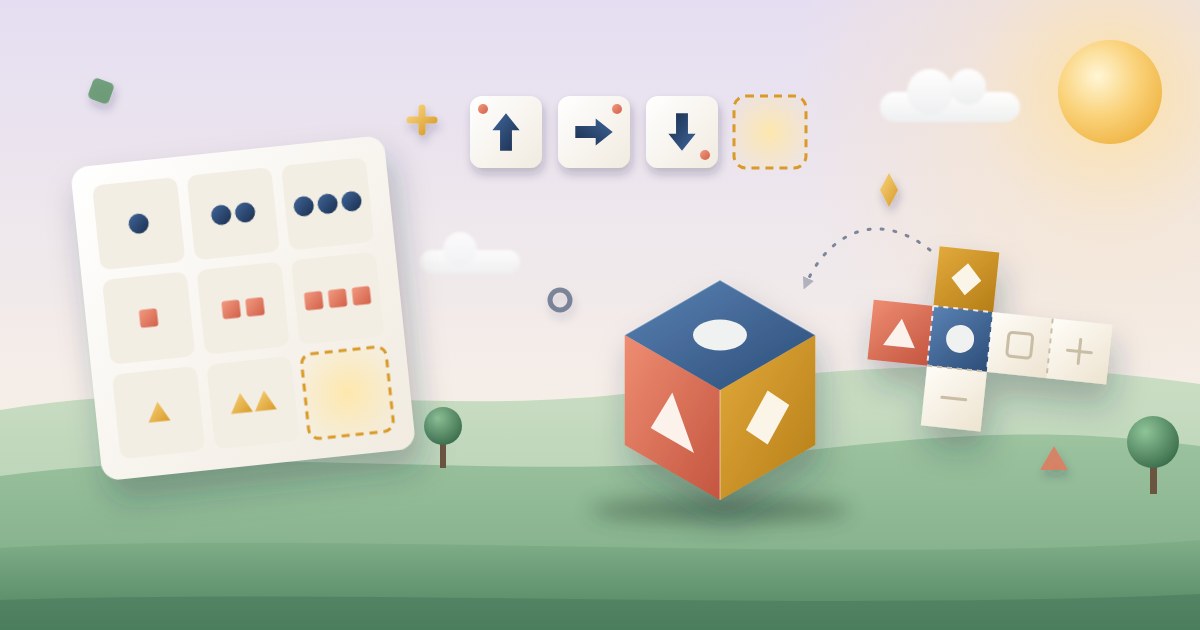
Non-verbal reasoning (NVR) uses shapes and patterns instead of words and numbers. For some children it is the most enjoyable part of the 11+; for others it feels like trying to read a language they have never been taught. In a sense, they are right: NVR is rarely taught in primary school.
What unlocks it is noticing that almost every NVR question, however busy the picture looks, is built from a small set of features that change according to a rule. Staring at the whole picture and waiting for the answer to jump out rarely works; checking one feature at a time usually does.
So start with the checklist below, then look at how it applies to each of the main non verbal reasoning question types. The NVR examples are described in words, because the method matters more than any single picture.
Start here: the feature checklist
Before looking at the answer options, children should scan the shapes for these features, one at a time:
|
Feature
|
What can change
|
|
Shape
|
Circle, triangle, square, star; number of sides
|
|
Number
|
How many shapes, lines, dots or sides
|
|
Size
|
Large, small, growing, shrinking
|
|
Shading
|
Black, white, striped, dotted; direction of stripes
|
|
Position
|
Top, bottom, inside, outside, which corner
|
|
Rotation
|
Turning clockwise or anticlockwise, by 45° or 90° steps
|
|
Reflection
|
Mirrored left to right or top to bottom
|
|
Line style
|
Solid, dashed, thick, thin, arrowheads
|
Checking features in the same order every time stops children from jumping at the first pattern they notice, which is often a distraction.
The main non-verbal reasoning question types
1. Series: NVR shapes and sequences
A row of boxes shows a shape changing step by step. Your child chooses the next box.
Example: an arrow points up, then right, then down. Each step it turns 90° clockwise, and a dot inside it moves from one corner to the next. The answer is the arrow pointing left, with the dot in the following corner.
Tip: look for two rules at once. Series questions often combine a movement with a change in number or shading.
2. Odd one out
Five figures are shown; four share a rule and one breaks it.
Example: five shapes each have a small black circle. In four, the circle sits inside the shape; in one, it sits outside. That one is the odd one out, even though it may look similar at first glance.
Tip: count everything. Sides, lines, dots and corners are the most common hidden differences.
3. Analogies
"This shape is to that shape as this one is to which?" The change from the first pair must be applied to a new shape.
Example: a white square becomes a smaller black square. A white triangle should therefore become a smaller black triangle.
Tip: describe the change in words ("gets smaller and turns black") before looking at the options.
4. Similarities (which is most like these?)
Two or three figures share a feature; your child picks the option that shares it too.
Example: three figures each contain exactly two shaded shapes, but the shapes and positions all differ. The answer is the option with two shaded shapes.
Tip: ignore anything that differs between the given figures. Only what they have in common matters.
5. Matrices (grids)
A grid of three by three or two by two has one empty square. Rules usually run across rows, down columns or both.
Example: in each row, the number of lines increases by one from left to right, and in each column the shading stays the same. The missing square needs the correct number of lines and the column's shading.
Tip: check rows and columns separately, then combine.
6. Codes
Figures are labelled with letter codes, and each letter stands for one feature. Your child works out the code for a new figure.
Example: the first letter represents shape (A = circle, B = square) and the second represents shading (X = black, Y = white). A white square is therefore BY.
Tip: compare two figures that share one letter. Whatever they have in common is what that letter means.
7. Reflections
Your child chooses the mirror image of a figure in a given line.
Tip: pick one distinctive detail, such as a dot or a flag, and track where it ends up. In a vertical mirror line, left and right swap but top and bottom stay the same.
8. Rotations
Your child identifies the same figure after it has been turned, often ruling out options that have been reflected instead.
Tip: a rotated figure can always be turned back to match the original; a reflected one cannot. Turning the page physically is a useful way to build this intuition during practice.
9. Nets and cubes: spatial reasoning in the 11+
A flat net is shown, and your child must decide which cube it folds into, or which net makes a given cube. Questions like these are often called spatial reasoning: they test whether your child can picture an object in three dimensions and turn it in their head.
Tip: faces that are opposite each other on a cube can never be seen together. On a net, faces separated by exactly one face in a straight row end up opposite each other. Folding real paper nets at home is one of the fastest ways to improve.
10. Hidden shapes and combined shapes
Your child finds a simple shape hidden within a complex figure, or chooses how two pieces fit together.
Tip: focus on the outline and distinctive angles of the target shape rather than the busy background.
How NVR is tested
Not every 11+ includes NVR. In Redbridge, non-verbal reasoning shares a paper with maths in the GL Assessment test. The Essex (CSSE) test has no reasoning papers. GL Assessment's own familiarisation pack includes both a non-verbal reasoning pack and a combined non-verbal reasoning and maths pack, which are free to download from GL's website.
Non-verbal reasoning tips: a practice plan
-
Teach the checklist first. Use simple examples until scanning features becomes automatic.
-
Practise one type at a time. Ten matrix questions in a row builds a method quickly.
-
Say the rule aloud. If your child can explain why an answer is right, they have understood the type.
-
Use real objects for spatial questions. Paper nets, a small mirror and cut-out shapes make rotations, reflections and cubes much easier to grasp.
-
Add timing in Year 5. Speed matters in NVR, but only once accuracy is secure. Two or three focused 20-minute sessions a week is a sensible starting point.
Non-verbal reasoning is one of the subjects Merit Tutors teaches in its 11+ preparation classes. If you would like to know how your child is doing now, its free assessment includes an 11+ maths and non-verbal reasoning option.
Ready to try it? Every paper in the library comes with its mark scheme and a
worked solution, so you can practise without hunting for files.
Find past papers