Verbal reasoning is the part of the 11+ that many parents have never seen before. It is not taught as a subject in most primary schools, yet in Redbridge it shares a paper with English, and Latymer's test includes a GL Assessment maths and verbal reasoning paper. (The Essex CSSE test no longer includes reasoning questions.)
At first glance the questions look endlessly varied. In practice they fall into four families, and the verbal reasoning question types within each family repeat from paper to paper. A child who can name the type in front of them has already done half the work. Each VR example below was written for this article and comes with a technique your child can reuse.
Exact question styles vary between tests. If your child is sitting a GL Assessment test, as in Redbridge, pair these examples with GL's official verbal reasoning familiarisation materials, which show how GL verbal reasoning types are laid out.
Family 1: hidden and missing letters
Hidden words
A word is hidden across the end of one word and the start of the next.
Find the four-letter word hidden in: The mouse ate the cheese.
Answer: seat (mouse ate).
Tip: run a finger along each pair of neighbouring words, reading across the gap.
A letter that completes two pairs of words
Find one letter that ends the first word and starts the second in both pairs: car [?] ape and mos [?] oad.
Answer: t (cart, tape; most, toad).
Tip: try the letter in the easier pair first, then check it in the other.
Moving a letter
Move one letter from the first word to the second to make two new words: stone, ten.
Answer: s (tone, tens).
Tip: try removing each letter of the first word in turn; only a few leave a real word.
Completing a word in a sentence
Three letters are missing from the capitalised word: The CH _ _ _ EN laid an egg.
Answer: ICK (CHICKEN).
Tip: read the sentence for meaning first; the context usually gives the word away.
Family 2: word meanings
These questions reward a wide vocabulary more than any technique.
Synonyms
Choose one word from each group that are closest in meaning: (fast, sad, open) (quick, happy, shut).
Answer: fast and quick.
Antonyms
Which word is most opposite in meaning to generous? (kind, mean, rich)
Answer: mean.
Odd ones out
Which two words do not belong with the others? apple, pear, carrot, plum, potato
Answer: carrot and potato (vegetables; the others are fruit).
Analogies
Hot is to cold as tall is to (short, high, wide).
Answer: short. The relationship is "opposite of".
Tip for all meaning questions: say the relationship out loud in a sentence ("hot is the opposite of cold") and test each option in the same sentence.
Compound words
Take one word from each group to make a new word: (hand, tree, cloud) (bag, salt, rock).
Answer: handbag.
Tip: check each first word against every second word systematically; it is easy to stop at a combination that only sounds plausible.
Family 3: letter sequences and codes
Keep an alphabet strip in front of your child while practising. Learning letter positions (A = 1, M = 13, Z = 26) by heart can also speed these questions up.
Letter sequences
Find the next letter: B, E, H, K, ?
Answer: N. Each letter is three places after the last.
Letter-pair analogies
AC is to BD as EG is to ?
Answer: FH. Each letter moves forward one place.
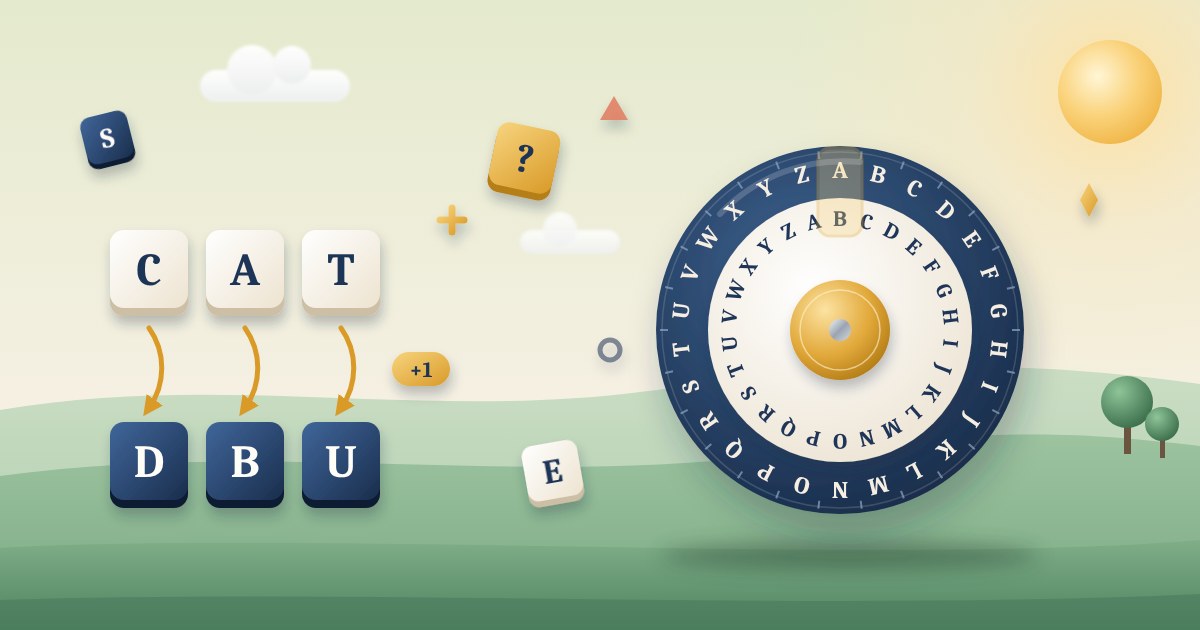
Letter-shift codes
If CAT is written as DBU, how is DOG written?
Answer: EPH. Each letter moves forward one place.
Tip: write the shift above each letter (+1, +1, +1). Some codes shift each letter by a different amount, or run backwards through the alphabet.
Number codes for words
If the code for TEAM is 5291, what is the code for MEAT?
T = 5, E = 2, A = 9, M = 1, so MEAT = 1295.
Tip: write the letter-number pairs in a small table before answering.
Family 4: numbers and logic
Number sequences
Find the next number: 2, 5, 11, 23, ?
Answer: 47. Each number is doubled, then 1 is added.
Tip: check the differences first (3, 6, 12). If they double, a "×2" rule is likely.
Balancing sums
Find the missing number: 7 + 9 = 4 × ?
Answer: 4, because 7 + 9 = 16 and 4 × 4 = 16.
Letters standing for numbers
If A = 2, B = 3, C = 5, D = 6 and E = 9, give the answer to A × D − B as a letter.
A × D = 12, and 12 − 3 = 9, so the answer is E.
Logic problems
Ali is taller than Ben. Ben is taller than Cara. Who is the shortest?
Answer: Cara.
Tip: draw a quick line or ladder and place each person on it as you read.
11+ verbal reasoning tips: how to practise well
-
Learn the types before timing them. Untimed practice builds understanding; speed comes later.
-
Group practice by type. Ten code questions in a row builds a method faster than a mixed paper.
-
Keep an error log. Note the question type for every mistake. Patterns usually appear quickly, showing which types need the most work.
-
Build vocabulary daily. Reading widely and keeping a word notebook helps with synonyms, antonyms, analogies and odd ones out.
-
Move to mixed, timed papers in Year 5. Real tests switch between types quickly. Before that, a few untimed puzzles a week in Year 4 are plenty.
If your child is finding verbal reasoning hard to crack at home, Merit Tutors teaches it alongside English, maths and non-verbal reasoning in its 11+ classes, and offers a free assessment with an 11+ English and verbal reasoning option.
Ready to try it? Every paper in the library comes with its mark scheme and a
worked solution, so you can practise without hunting for files.
Find past papers