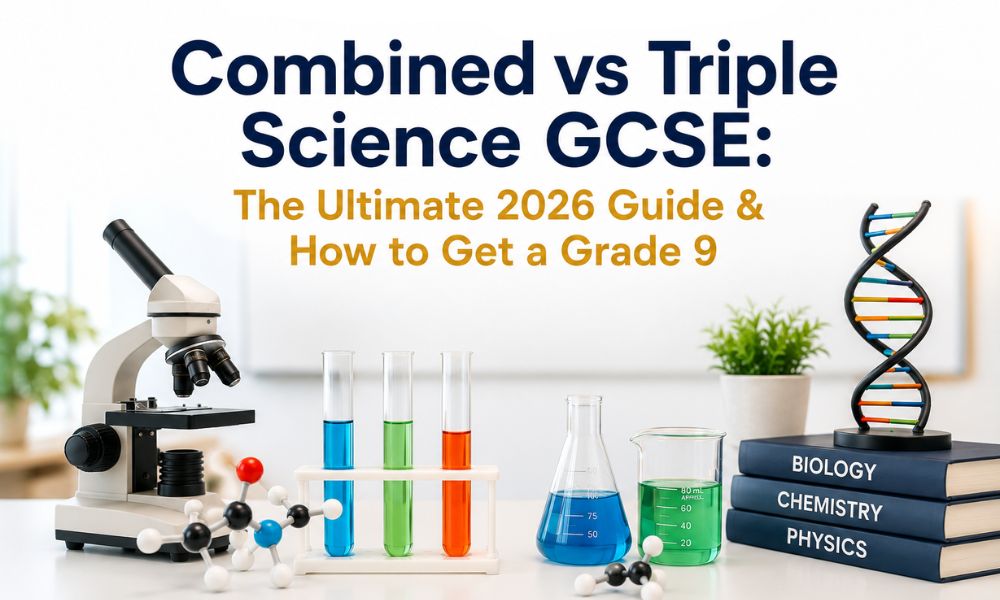
Combined Science gives you two GCSE grades and covers the core concepts of Biology, Chemistry, and Physics. Triple Science covers the same subjects in much greater depth, rewarding you with three separate GCSE grades. Neither is inherently "better," but Triple Science is highly recommended if you definitely want to study STEM subjects at A-Level or university. To get a Grade 9 in either, you must abandon reading textbooks and focus entirely on active recall and past paper topic questions.
If you are a student moving from Year 9 into Year 10 (or a parent guiding them), you are likely facing the biggest academic decision of your secondary school career so far: Should you choose Combined Science or Triple Science?
Schools across the UK handle this differently. Some allow students to freely choose, while others use Year 9 mock exams to dictate which tier a student is allowed to enter. The terminology alone is confusing, and the rumors in the playground—"If you do Combined Science, you can't be a doctor!"—only make it worse.
At Merit Study Resources, we analyze the data behind thousands of successful Grade 9 students. In this comprehensive 2026 guide, we will debunk the myths, compare the two pathways, and show you exactly how to revise to hit the top grades using the best resources available.
The Big Differences Explained (Comparison Table)
Before you make a choice, you need to understand exactly what you are signing up for.
|
Feature |
Combined Science (Double Award) |
Triple Science (Separate Sciences) |
|
Subjects Covered |
Biology, Chemistry, Physics |
Biology, Chemistry, Physics |
|
Number of GCSEs |
2 GCSE Grades (e.g., 7-7, 8-7) |
3 GCSE Grades (e.g., 9, 8, 8) |
|
Content Volume |
Standard workload. |
Roughly 30% more content to memorize. |
|
Exam Time |
6 exams (1 hr 15 mins each) |
6 exams (1 hr 45 mins each) |
|
Ideal For... |
Students wanting a balanced workload alongside other subjects like Humanities or Arts. |
Students with a deep passion for science who plan to pursue STEM careers. |
The "Double Grade" Explained
If you take Combined Science, your marks across all three sciences are added together, and you are awarded two grades. For example, if you get an 8-7, it means you performed at a high level across the board. However, if you are amazing at Biology but terrible at Physics, your Physics score will drag your overall double grade down.
In Triple Science, you get separate grades. You could get a Grade 9 in Biology, an 8 in Chemistry, and a 5 in Physics.
Myth-Busting: Can I take A-Level Sciences with Combined?
Let's kill the biggest playground rumor right now: Yes, you absolutely can study A-Level Sciences if you take Combined Science.
Most sixth forms and colleges in the UK require a minimum of a 6-6 or 7-7 in Combined Science to let you onto an A-Level Biology, Chemistry, or Physics course.
However, be warned: The jump from GCSE Combined Science to A-Level Science is massive. Triple Science students have a significant advantage in the first few months of Year 12 because they have already covered some of the foundational A-Level concepts during their GCSEs (such as titration calculations in Chemistry or the eye structure in Biology).
How to Get a Grade 9 in GCSE Science
Whether you choose Combined or Triple, the strategy to get a Grade 9 (the equivalent of a high A*) is exactly the same. The biggest mistake students make is relying on "passive revision"—reading the textbook and highlighting it in three different colors.
To get a Grade 9, you must switch to Active Revision.
Active Recall
Do not read notes. Test yourself. If you are learning about the heart, cover the diagram and try to draw and label it from memory. If you get it wrong, look at the answer, cover it again, and try again. This forces your brain to build neural pathways.
Master the Mark Scheme Vocabulary
GCSE Science examiners are ruthless. You can describe a biological process perfectly, but if you do not use the specific "buzzwords" required by the AQA or Edexcel mark scheme, you will get zero marks.
-
Wrong: "The enzyme gets too hot and stops working."
-
Right: "The enzyme denatures because the high temperature changes the shape of the active site."
Brutal Past Paper Practice
You should spend 20% of your time making notes and 80% of your time doing past papers. Doing full past papers is good, but doing Topic-by-Topic questions is how you secure a Grade 9. If you struggle with 'Quantitative Chemistry', you should do 50 questions exclusively on that topic until it becomes second nature.
The Best Revision Platforms: PMT vs. Save My Exams vs. Merit
To practice topic questions, you need a high-quality resource bank. Students typically turn to three platforms:
Physics & Maths Tutor (PMT):
A fantastic free resource. However, it is essentially a massive "data dump." The PDFs are often messy, out of order, and finding the exact topic for your specific exam board can be overwhelming.
Save My Exams:
A very polished platform with excellent notes. However, it is heavily paywalled, and their subscription fees can be expensive for students who just want access to well-organized questions.
Merit Study Resources:
We bridge the gap. At Merit Study Resources, we provide hyper-organized, exam-board specific (AQA, Edexcel, OCR) Topic Questions and Model Answers. We remove the clutter of PMT and offer a much more affordable, focused alternative to Save My Exams. Our worksheets are designed specifically to drill the exact wording examiners are looking for.
Checklist: Which Pathway is Right for You?
Still undecided? Use this quick checklist.
Choose Triple Science if:
-
You consistently score above 70% in your Year 9 science tests.
-
You genuinely enjoy science and read about it outside of school.
-
You know you want to be a doctor, engineer, or research scientist.
-
You are prepared to memorize 30% more content.
Choose Combined Science if:
-
You find science okay, but you prefer Humanities (History, Geography) or Arts.
-
You want to keep your options open and prefer a balanced workload.
-
You struggle with the math equations in Physics and Chemistry.
Frequently Asked Questions (FAQs)
Q: What is the difference between Combined and Triple Science?
A: Combined Science results in two GCSE grades and covers core concepts. Triple Science covers all three subjects in greater depth and results in three separate GCSE grades.
Q: Can I do A-Level Science if I take Combined Science?
A: Yes, absolutely. Most sixth forms accept students onto A-Level Science if they achieve high grades (usually a 7-7) in Combined Science.
Q: Is Triple Science much harder than Combined Science?
A: It is not necessarily 'harder' in terms of difficulty, but it is much more demanding in terms of the volume of content and the length of the exams.
Q: What is the best way to revise for GCSE Science?
A: The best way to revise is to use Active Recall and rigorous past paper practice using targeted topic questions from platforms like Merit Study Resources.
Q: Which is better: PMT or Save My Exams?
A: PMT is great for free, bulk past papers, while Save My Exams is better for structured notes. However, Merit Study Resources provides the most affordable, highly-structured topic questions specifically designed to help you hit Grade 9 mark schemes.
Secure Your Grade 9 Today
Do not leave your GCSE Science grades to chance. Whether you are studying Combined or Triple, the secret to success lies in targeted, relentless practice.
Skip the messy PDF downloads and the expensive subscriptions. Get the exact worksheets, model answers, and revision guides you need to master your exam board.
Explore the Merit Study Resources GCSE Science library today and start your journey to a Grade 9!