If you are revising GCSE Maths, the smartest question is not “What might come up?” but “What keeps coming up?” That shift matters. It moves you away from wishful thinking and toward pattern recognition.
Official exam-board materials back that up. Pearson’s own content guidance explains that it uses generic examples and references to recent exam papers and specimen sets to show how the specification is assessed, which is exactly why past papers are so powerful: they show the recurring shapes that exam questions take, even when the numbers and context change. AQA and OCR present the same broad content areas too: number, algebra, ratio/proportion, geometry/measures, probability, and statistics.
So if your goal is to rank up marks quickly, you should prioritise the recurring forms that appear across boards and across years, then train yourself to recognise them fast.
What really repeats in GCSE Maths
The clearest way to think about repetition is by question family, not by single topic name. For example, “quadratics” might return as factorising, solving, sketching, completing the square, or interpreting roots and turning points. “Graphs” might mean equation of a straight line, gradient from coordinates, simultaneous equations by graph, or a real-life graph such as distance-time or speed-time. Pearson’s content guidance repeatedly maps these sub-skills to papers from June 2017 onward, which shows that these are stable assessment habits rather than one-off surprises.
The strongest public frequency snapshot comes from Edexcel Higher. Across full series from June 2017 to November 2023, the tracker shows direct and inverse proportion, ratio, compound interest, compound units, area, and histograms at 100%, while fractional indices, algebraic fractions, trigonometry, box plots, iterative processes, and bounds sit around 92%. Circle theorems and cumulative frequency are around 85%, straight-line equations around 77%, simultaneous equations and factorising quadratics around 62%, and reverse percentage around 54%. That is not a prediction tool, but it is a very strong steer on where your revision hours are most likely to pay off.
Official board materials line up with that picture. AQA’s specimen paper includes original-price percentage work, Venn diagrams, simultaneous graphs, ratio, direct proportion, histograms, and trigonometric modelling, while OCR’s specification overview explicitly lists direct/inverse proportion, graphs, Pythagoras, trigonometry, combined events, and statistics as core assessment content.
The question families worth mastering
The first family is algebra, and for Higher students it is the biggest one. AQA allocates about 30% of Higher marks to algebra, and public frequency data shows a long tail of repeated algebraic forms: indices, subject of formula, equations of lines, simultaneous equations, algebraic fractions, factorising quadratics, completing the square, and nth-term questions. Pearson’s official guidance also gives repeated examples for quadratic factorising and quadratic sequences from recent papers. The best solving template here is simple: translate the words into algebra, simplify cleanly, get everything into a usable form, solve, then check by substitution or sense-checking the roots.
The second family is fractions, percentages, ratio, and proportion, which is where many grades wobble. AQA’s sample materials include the classic “sale price after a fractional reduction” form and a direct proportion question, while Edexcel’s frequency data makes ratio and direct/inverse proportion some of the most persistent higher-tier appearances. Your template here should be almost automatic: for percentages, convert to a multiplier, then decide whether you are finding the new amount or reversing back to the original; for ratio, find one part, then scale; for direct/inverse proportion, write the proportional equation first, then substitute the given pair of values.
The third family is probability and statistics, especially Venn diagrams, tree diagrams, cumulative frequency, box plots, and histograms. Pearson’s guidance references tree diagrams and grouped-data diagrams repeatedly from live papers, and OCR’s 2024 examiner report shows a very familiar mistake: students treated a histogram like a frequency bar chart instead of remembering that area, not height alone, represents frequency. That is exactly why these questions repeat so effectively: the maths is not always hard, but the interpretation is easy to get wrong under pressure.
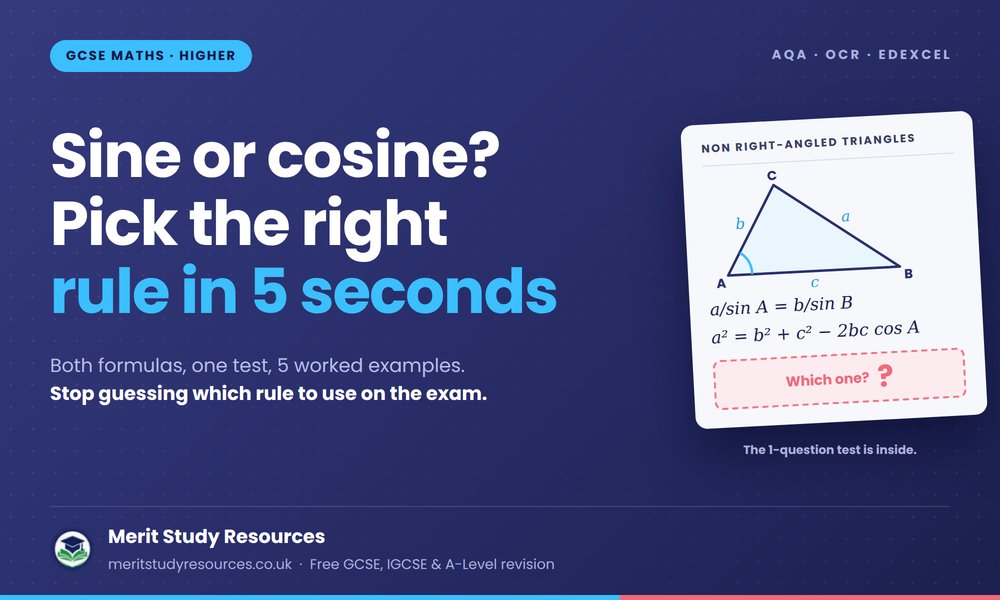
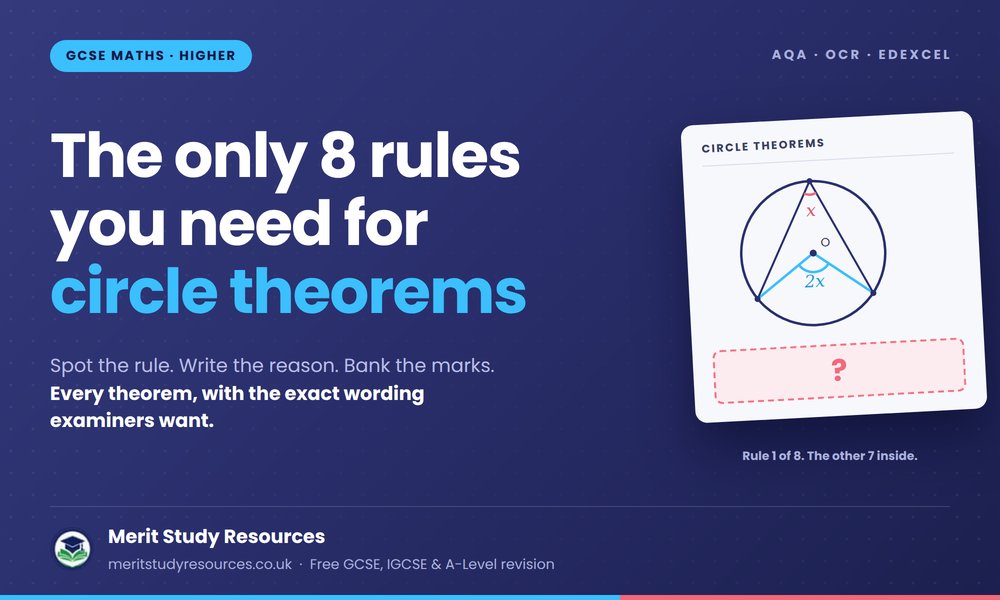
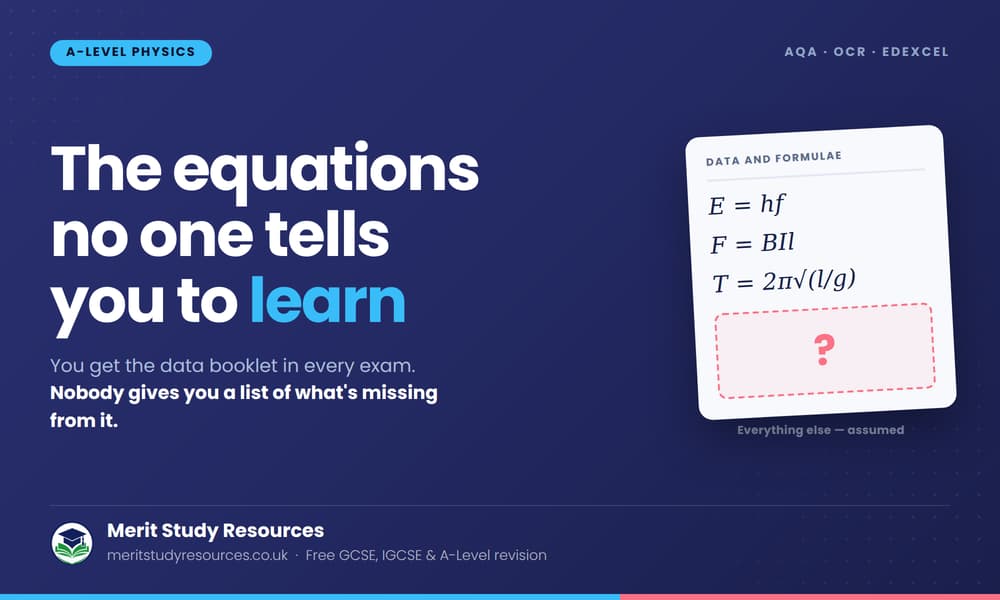
The fourth family is geometry, trigonometry, and graphs. On the public frequency tracker, trigonometry appears in roughly 92% of full Edexcel Higher series, circle theorems around 85%, straight-line equations about 77%, and Pythagoras around 69%. AQA’s specimen paper includes simultaneous equations by graph, circle and angle work, and a trigonometric “big wheel” model, while OCR’s examiner report notes that similar distance/Pythagoras style questions had been set before and that many candidates were well prepared for them. Since 2025–2027, AQA, Pearson, and OCR all provide GCSE Maths formula inserts or exam aids, but OCR still reports that students often did not use formulae correctly even when they were given. In other words, memorising less does not remove the need to choose the right method.
The mistakes that keep costing marks
The good news is that many GCSE Maths mistakes are predictable. The bad news is that they are predictable because students keep making them year after year.
Pearson’s 2024 examiner feedback shows that students still lose marks on fraction questions by mishandling improper fractions, common denominators, and simple arithmetic when subtracting numerators. OCR’s report shows the same pattern of avoidable error in different clothing: treating histograms as ordinary bar charts, writing incorrect inequality regions, evaluating expressions with negative numbers badly, or choosing the wrong geometry method. OCR also warns that candidates often rounded too early or failed to use formulae correctly, even when those formulae were available on the sheet.
There is also an exam-technique issue that strong students sometimes underestimate. Pearson’s official guidance explains that process and method marks reward a valid route, but when a question specifically requires working, the right answer with no working can score no marks. That means your habit of writing down the setup is not optional; it is part of the mark scheme.
How to practise repeated questions
The best strategy is not to do random past-paper pages forever. It is to build a repeat loop around the recurring families. First, do a short set of one family only: for example, six percentage and ratio questions in twenty minutes. Then mark them and write one line beside each error explaining what actually went wrong: wrong multiplier, wrong denominator, wrong formula, wrong graph reading, or not forming the equation. After that, do a mixed set where those topics are hidden among others, because that is what the real exam does.
A smart place to source those papers is the GCSE Maths past papers hub on Merit Study Resources, which pulls together board-specific materials in a clean revision workflow. Their own GCSE Maths revision advice also recommends at least one past paper a week in the final six weeks, increasing frequency as the exam gets closer. That is sensible because repetition matters more than cramming.
These are seven high-value practice prompts worth doing because they mirror recurring official forms.
Reverse percentage: “After a 15% discount, a coat costs £51. Find the original price.” Model route: identify that £51 is 85%, write original × 0.85 = 51, solve, then sense-check.
Ratio: “Red : blue = 3 : 5 and there are 64 counters. How many are blue?” Model route: total parts, one part, multiply.
Direct proportion: “y is directly proportional to x²; y = 18 when x = 3. Find y when x = 5.” Model route: find the constant first.
Quadratic equation: “Solve x² − 7x + 12 = 0.” Model route: rearrange to zero, factorise, state both roots. Indices: “Simplify x³ × x⁵ ÷ x².” Model route: add powers when multiplying, subtract when dividing.
Histogram/statistics: “A histogram bar of width 5 has frequency 20. What is the frequency density?” Model route: frequency ÷ class width.
Trigonometry/graphs: “A ladder 5 m long reaches 4.6 m up a wall. How far is the foot from the wall?” Model route: recognise right-angled triangle, use Pythagoras, round only at the end. These are not copied past-paper questions, but they are deliberately shaped like the question families official papers keep revisiting.
Frequently asked questions
Do the exact same GCSE Maths questions come up every year?
Not usually. What repeats is the form of the question: the same method, the same structure, or the same topic family in a different context. Pearson’s guidance explicitly uses recent exam-paper references to illustrate how the same content is assessed over time.
Which GCSE Maths topics should I revise first for the biggest payoff?
Start with algebra, ratio/proportion, percentages, graphs, trigonometry, and probability/statistics, because those areas recur heavily across official specifications and public frequency trackers.
Are formula sheets enough for trigonometry and geometry questions?
No. A formula sheet helps, but OCR’s examiner reporting shows students still lose marks by choosing the wrong formula or applying it badly.
How often should I do past papers?
A good final-stretch target is at least one full paper per week, increasing as exams approach, while also doing short topic drills on repeated question families.
What is the biggest avoidable mistake in GCSE Maths?
Losing method marks through careless setup: wrong denominator, wrong multiplier, wrong equation, or no working shown when the question requires it.
Final thoughts
If you remember one thing from this guide, make it this: GCSE Maths rewards recognition. The students who improve fastest are usually the ones who stop seeing every paper as brand new and start seeing it as a set of familiar patterns in new clothes.
So revise the repeated families first, correct your errors properly, and keep returning to the same forms until your first step feels automatic. If you want more structured paper-by-paper practice, the GCSE Maths resources on Merit Study Resources are a strong next step, and if repeated question types are still exposing the same gaps, the GCSE Maths Revision Course at Merit Tutors is designed around targeted exam support and confidence building.
For the landscape thumbnail, the strongest concept would be a clean exam-desk scene with a calculator, squared paper, and a worked algebra line next to a bold overlay reading GCSE Maths Most Repeated Questions. A second strong option would be a split layout showing algebra, ratio, and geometry icons around a central exam paper in blue-and-white exam tones.
If you want targeted help on the question families that keep coming up, explore the GCSE Maths Revision Course at Merit Tutors and turn repeated weak spots into reliable marks.
Ready to try it? Every paper in the library comes with its mark scheme and a
worked solution, so you can practise without hunting for files.
Find past papers