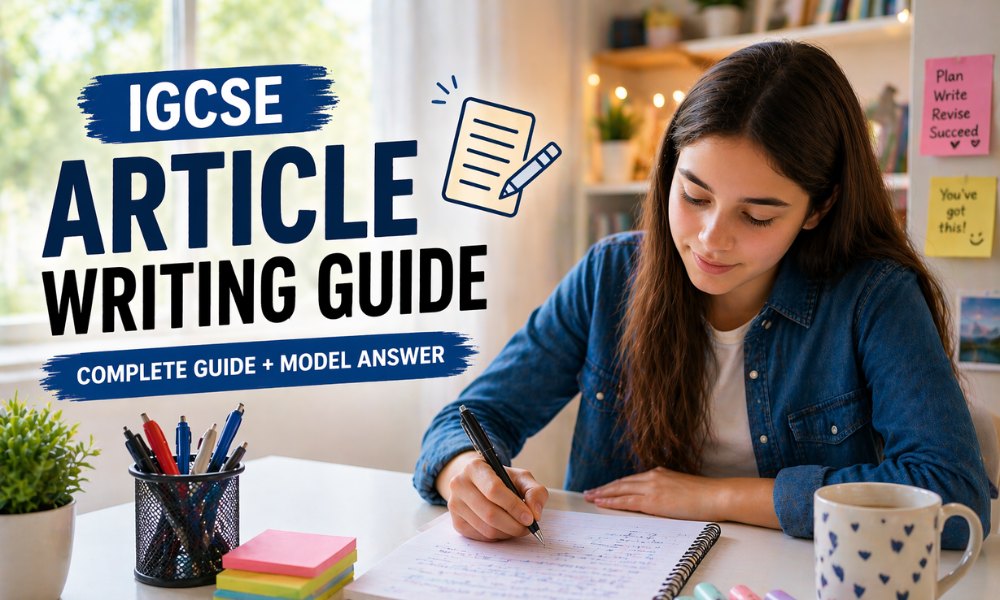
If you’ve ever searched for “IGCSE article sample” or “model answer”, you’re not alone.
Almost every student preparing for IGCSE English wants to see a perfect answer. It feels like the easiest way to understand what examiners expect. But here’s something important that many students miss:
Reading a model answer is helpful, but understanding why it works is what actually improves your writing.
Because in the exam or coursework, the topic will change. The question will be different. But the skills you use — structure, tone, clarity — will always stay the same.
This guide is designed to help you master those skills, so you can confidently write a high-scoring article on any topic.
What makes an IGCSE article different?
An IGCSE article is not the same as an essay.
Essays are usually formal, structured, and focused on arguments. Articles, on the other hand, are more engaging and reader-friendly. They are written for a specific audience, often in a magazine, blog, or newspaper format.
That means your writing should feel natural, interesting, and slightly conversational — without becoming too informal.
Think of it this way:
You’re not just answering a question.
You’re writing something people actually want to read.
Understanding what examiners look for
Examiners are not just checking your grammar or vocabulary.
They are looking at how well you communicate your ideas. A high-scoring article shows clear thinking, strong organisation, and an ability to engage the reader.
A good response usually starts with an introduction that immediately draws the reader in. This could be through a question, a relatable situation, or a bold statement.
The main body should develop your ideas clearly. Each paragraph should have a purpose, whether it is explaining a point, giving an example, or presenting a different perspective.
Finally, the conclusion should leave a lasting impression. It should not just repeat ideas, but bring everything together in a meaningful way.
Model Answer Article (A* Level Example)
Are We Losing Real Connections in a Digital World?
Have you ever noticed how easy it is to talk to someone online, yet how difficult it can feel to have a real conversation face to face?
In today’s world, technology is everywhere. From social media to instant messaging, we are constantly connected. At first glance, this seems like a positive change. Communication has never been faster or more convenient. However, this convenience is slowly changing the way we interact with each other.
Many people now spend more time looking at screens than talking to the people around them. It is not unusual to see friends sitting together, each focused on their own phone. While they are physically present, they are not truly engaging with one another.
This shift has created what can be described as an “illusion of connection.” We may have hundreds of online contacts, but how many of these relationships are meaningful? A quick message or a like on a post cannot replace a real conversation where emotions, tone, and expressions play an important role.
Another concern is the impact on mental health. Constant exposure to carefully edited versions of other people’s lives can create pressure and comparison. This often leads to feelings of insecurity or loneliness, especially among young people.
Despite these issues, it would be wrong to say that technology is entirely negative. When used properly, it can strengthen relationships. It allows families to stay in touch across long distances and gives people the opportunity to connect with others who share similar interests.
The real problem is not technology itself, but how we use it. Finding a balance is essential. Making time for real conversations and reducing screen time can help restore genuine human connection.
In the end, technology should support our relationships, not replace them. If we become more aware of how we use it, we can enjoy its benefits without losing what matters most.
Why this answer works
What makes this article effective is how naturally it flows.
The introduction immediately connects with the reader by asking a simple but powerful question. From there, each paragraph builds on the previous idea, creating a clear and logical progression.
The tone remains balanced throughout. It does not sound too formal, but it is also not overly casual. This is exactly what examiners expect in an article.
The conclusion is also strong because it does more than summarise. It leaves the reader with a clear message and something to think about.
How to write like this in your exam
The key is not to memorise this answer, but to understand the method behind it.
Start by thinking about your reader. What would make them interested in your topic? How can you make your introduction engaging?
As you write, focus on explaining your ideas clearly. Avoid trying to use complicated words just to sound impressive. Clarity is always more important.
It is also helpful to include examples or real-life situations. This makes your writing more relatable and easier to understand.
Finally, make sure your ending feels complete. A weak conclusion can reduce the overall impact of your article.
Common mistakes students make
Many students lose marks not because they lack ideas, but because of how they present them.
One common issue is writing in a style that feels too much like an essay. This makes the article less engaging and less suitable for the intended audience.
Another mistake is having no clear structure. Jumping between ideas without proper organisation makes it difficult for the examiner to follow your argument.
Some students also focus too much on vocabulary and forget about clarity. Using complex words incorrectly can weaken your writing instead of improving it.
How to improve your article writing
Improvement comes from practice, but it has to be the right kind of practice.
Instead of writing randomly, focus on understanding what works. Read high-quality examples, analyse their structure, and try to apply similar techniques in your own writing.
You can also review your past answers and identify areas where you can improve. This could be your introduction, your paragraph structure, or your conclusion.
Over time, these small improvements add up and make a big difference.
You can explore more structured English resources here:
https://meritstudyresources.co.uk/past-papers
FAQ
What is the format of an IGCSE article?
An article usually includes a title, introduction, main body, and conclusion written in an engaging tone.
Can I use informal language in an article?
You can use a slightly conversational tone, but avoid being too informal.
How long should an IGCSE article be?
It typically depends on the question, but clear structure is more important than length.
Do I need to use complex vocabulary?
No, clarity is more important than complexity.
How can I improve quickly?
Practice regularly and focus on structure and clarity rather than memorisation.
Final Thoughts
IGCSE article writing is not about being perfect — it’s about being clear, engaging, and structured.
Once you understand what examiners are looking for, the task becomes much easier. Instead of worrying about what to write, you can focus on how to write effectively.
With consistent practice and the right approach, achieving a high grade is completely possible.
Because at the end of the day, the best answers are not the most complicated ones — they are the ones that communicate ideas clearly and confidently.
🔗 Helpful Resources
-
Practise with GCSE past papers
-
Book your GCSE exams as a private candidate