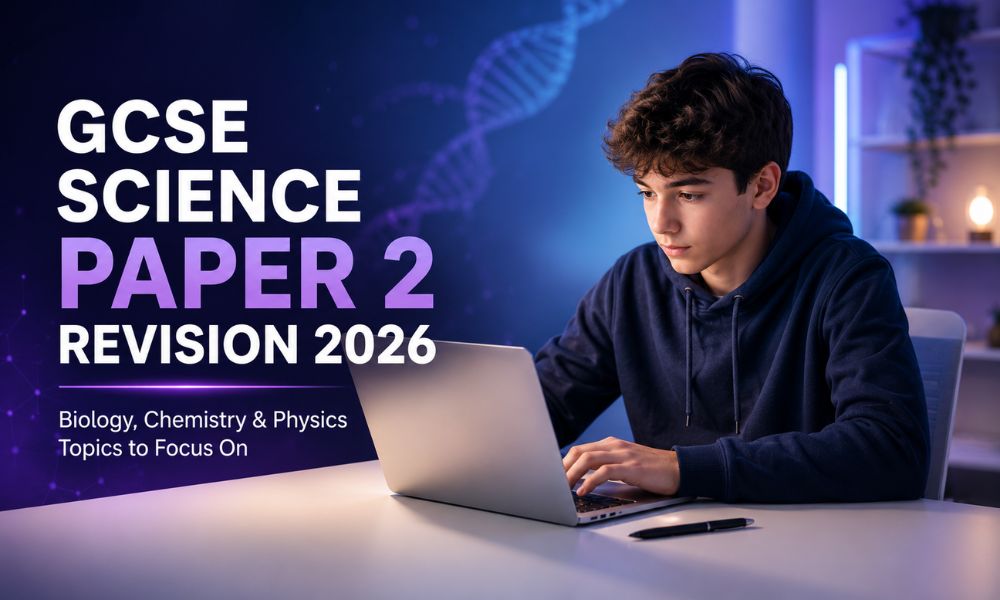
GCSE Science Paper 2 can feel different from Paper 1. By the time students reach the later science papers, they are often tired from weeks of exams, but there is still a lot to revise. Biology, Chemistry and Physics Paper 2 questions can test detailed knowledge, practical skills, calculations, graphs and the ability to apply ideas in unfamiliar contexts.
The good news is that Paper 2 revision does not need to be chaotic. With a clear plan, students can focus on the topics most likely to matter, practise exam-style questions and use mark schemes to sharpen their answers.
At Merit Study Resources, students can access past papers, revision materials and study support for GCSE, IGCSE and A-Level exams. This guide explains how to prepare for GCSE Science Paper 2 in 2026, with separate advice for Biology, Chemistry and Physics.
Check Your Exam Board First
Before revising, check your exam board and course. GCSE Science can be assessed as Combined Science or separate Biology, Chemistry and Physics. The topics, paper structure and question style can vary between AQA, Pearson Edexcel and OCR.
Students should use their own specification, class notes and exam board timetable. Official sources such as AQA past papers and mark schemes, Pearson Edexcel past papers and the OCR past paper finder are useful for checking real past papers and mark schemes.
Do not revise only from random online lists. Use them as support, but always compare them with your course specification.
GCSE Biology Paper 2 Revision
Biology Paper 2 often includes topics that require both memory and explanation. Students may need to understand biological processes, interpret data and use accurate scientific vocabulary.
Common Biology Paper 2 areas may include homeostasis, hormones, the nervous system, inheritance, variation, evolution, ecology and the control of body conditions. Depending on the exam board, questions may ask students to explain processes, interpret graphs, describe required practicals or evaluate data.
One of the best ways to revise Biology is active recall. Close your notes and try to explain a process from memory. For example, explain how blood glucose is controlled, how selective breeding works or how organisms are adapted to their environment. Then check your notes and fill in missing details.
Biology mark schemes often reward specific terms. Words like hormone, receptor, enzyme, allele, mutation, population, community and biodiversity may matter. Students should practise using the correct vocabulary rather than writing vague answers.
GCSE Chemistry Paper 2 Revision
Chemistry Paper 2 often tests application. Students may understand the basic idea but lose marks because they do not explain observations clearly or cannot link the question to the correct topic.
Common Chemistry Paper 2 areas may include rates of reaction, reversible reactions, organic chemistry, chemical analysis, the atmosphere, using resources and sustainability. Some boards may also test calculations, graphs and practical method questions.
For Chemistry, students should revise definitions and processes, then practise applying them to exam questions. For example, it is not enough to know that increasing temperature increases rate of reaction. Students should be able to explain that particles have more energy, move faster and collide more frequently with enough energy to react.
Required practicals are also important. Students should know the method, variables, safety points, expected results and how to improve reliability. Even if the exact practical does not appear, the skills can be tested in unfamiliar contexts.
GCSE Physics Paper 2 Revision
Physics Paper 2 can feel challenging because it often includes equations, graphs and abstract ideas. Students need to understand the concept, choose the right equation and show working clearly.
Common Physics Paper 2 areas may include forces, waves, magnetism, electromagnetism, space physics for some separate science courses, and practical skills involving measurements or graphs. Combined Science and separate Physics may differ, so check your specification carefully.
For Physics, do not only memorise equations. Practise choosing the correct equation from the information in the question. Identify the known values, convert units if needed, substitute carefully and give the correct unit in your answer.
Students should also practise graph interpretation. Physics questions often include gradients, proportional relationships, anomalous results, uncertainty or conclusions from data. These questions can be good sources of marks if students slow down and read carefully.
Combined Science Paper 2: What to Watch For
Combined Science students usually sit papers that include Biology, Chemistry and Physics across the qualification. Paper 2 topics may feel broad because students have to switch between different sciences.
The key is to revise in blocks. Spend one session on Biology, one on Chemistry and one on Physics, rather than jumping between all three every few minutes. This helps your brain build stronger topic links.
Combined Science students should also use past papers to practise switching subjects under exam conditions. In the real exam, you may move from a Biology graph to a Chemistry explanation to a Physics calculation. Mixed practice helps build that flexibility.
Use Past Papers the Right Way
Past papers are essential for Science Paper 2 revision, but they only help if you learn from them. Do not just complete a paper and count the score. Look at every lost mark and ask why it happened.
Was the problem weak knowledge, poor wording, missing units, wrong equation, weak graph skills or misunderstanding the question? Each mistake tells you what to revise next.
Mark schemes are especially important in Science because examiners often look for specific points. If the mark scheme says "particles collide more frequently", writing "particles move more" may not be enough. Learn the style of answer examiners reward.
Students can also use topic questions before full papers. If you are weak on rates of reaction, practise that topic directly before attempting a full Chemistry Paper 2. If you struggle with forces, practise forces questions before a full Physics paper.
A 7-Day Science Paper 2 Revision Plan
If your Paper 2 exams are close, keep the plan simple. Trying to revise everything at once can cause panic.
Day 1: List weak topics for Biology, Chemistry and Physics. Use mock results, class tests or past papers.
Day 2: Revise Biology Paper 2 topics using active recall and short exam questions.
Day 3: Revise Chemistry Paper 2 topics, especially practicals, rates, organic chemistry and analysis where relevant.
Day 4: Revise Physics Paper 2 topics, focusing on equations, forces, waves and graphs where relevant.
Day 5: Complete mixed topic questions from all three sciences.
Day 6: Attempt a timed paper or timed sections and mark carefully.
Day 7: Redo wrong questions, review key definitions and rest properly before the exam.
This plan can be adjusted depending on exam dates, but the method stays the same: revise, practise, mark, correct and repeat.
Final Exam Tips for Science Paper 2
In the exam, read the command word carefully. Describe, explain, calculate, compare and evaluate all require different styles of answer. Check units in calculation questions. Use information from graphs and tables rather than relying only on memory.
For six-mark questions, plan before writing. A clear structure can gain more marks than a long but messy answer. Use scientific vocabulary and avoid vague phrases.
If you get stuck, move on and return later. Science papers often include easier marks after difficult questions, so do not lose time fighting one problem for too long.
Find GCSE Science Past Papers and Revision Resources
GCSE Science Paper 2 revision works best when students combine topic knowledge with exam practice. Use your specification, practise topic questions, complete past papers and learn from mark schemes.
Merit Study Resources provides past papers and revision support for GCSE, IGCSE and A-Level students. Start with the past papers hub, then build your revision around the subjects and exam boards you are taking.
The goal is not to revise everything perfectly. The goal is to make your next hour of revision useful. Focus on weak topics, practise real questions and correct mistakes before exam day.
FAQs
What topics are in GCSE Science Paper 2?
GCSE Science Paper 2 topics depend on the exam board and whether you take Combined Science or separate Biology, Chemistry and Physics. Common areas include ecology, inheritance, rates of reaction, organic chemistry, forces, waves and magnetism.
How should I revise for GCSE Biology Paper 2?
Use active recall for key processes, practise data questions and learn specific scientific vocabulary from mark schemes.
How should I revise for GCSE Chemistry Paper 2?
Focus on topic understanding, required practicals, rates of reaction, organic chemistry, chemical analysis and exam-style explanations.
How should I revise for GCSE Physics Paper 2?
Practise choosing equations, converting units, interpreting graphs and explaining ideas such as forces, waves and magnetism.
Are past papers useful for GCSE Science Paper 2?
Yes. Past papers help students understand question style, mark schemes, timing and how topics are applied in exams.