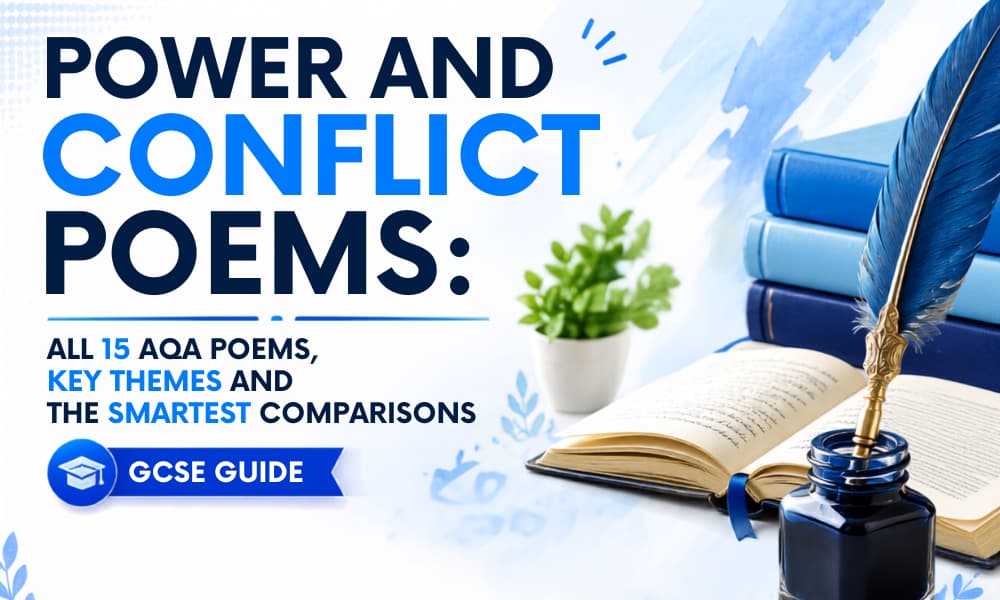
The Power and Conflict cluster is a group of 15 poems from the AQA GCSE English Literature poetry anthology, examined in Paper 2 through one 30-mark comparison question. You're given one poem printed on the exam paper and must compare it with a second poem — from memory.
That last part is why this section makes or breaks so many grades: you can't revise all 15 poems equally deeply, and you don't need to. This guide gives you the full poem list, the theme map that connects them, the comparison pairs that work in almost any question, and a revision method that fits how the exam actually tests you.
In this guide:
-
What is the Power and Conflict anthology?
-
All 15 Power and Conflict poems
-
The theme map: which poems connect
-
How the exam question works
-
Which poems should you compare?
-
How to revise Power and Conflict poetry
-
FAQs
What is the Power and Conflict anthology?
Power and Conflict is one of the two poetry clusters in the AQA GCSE English Literature anthology (the other is Love and Relationships — schools study one, not both). It contains 15 poems spanning Romantic classics to contemporary work, all exploring power — of nature, of rulers, of memory — and the human cost of conflict.
It sits in AQA GCSE English Literature (8702), Paper 2, Section B. If your school does AQA and you've studied Ozymandias, London and Exposure — this is your cluster.
All 15 Power and Conflict poems
The anthology contains 15 poems: eight broadly about the power of humans and nature, and seven rooted in war and its aftermath. Here's the full list with what each poem is really about:
| Poem | Poet | What it's really about |
|---|---|---|
| Ozymandias | Percy Bysshe Shelley | Human power is temporary; nature and time outlast every tyrant |
| London | William Blake | Institutional power crushing ordinary people; protest |
| Extract from, The Prelude | William Wordsworth | Nature's overwhelming power humbling a confident young man |
| My Last Duchess | Robert Browning | Control, jealousy and the abuse of power in a marriage |
| The Charge of the Light Brigade | Alfred Lord Tennyson | Heroism and duty — and the questionable orders behind them |
| Exposure | Wilfred Owen | War's real enemy: cold, waiting and nature, not battle |
| Storm on the Island | Seamus Heaney | A community braced against nature's siege-like power |
| Bayonet Charge | Ted Hughes | A soldier's terror mid-charge; patriotism evaporating |
| Remains | Simon Armitage | PTSD — a killing that follows a soldier home |
| Poppies | Jane Weir | A mother's grief and fear as her son leaves for war |
| War Photographer | Carol Ann Duffy | Distance, guilt and how comfortable societies consume conflict |
| Tissue | Imtiaz Dharker | Paper as a metaphor: human power is fragile and temporary |
| The Emigrée | Carol Rumens | Memory of a homeland that conflict has made unreachable |
| Checking Out Me History | John Agard | Identity and the power of controlling whose history gets told |
| Kamikaze | Beatrice Garland | A pilot who turns back — and the silence that punishes him |
For a deep dive on the anthology's most famous poem, start with our Ozymandias analysis guide.
The theme map: which poems connect
Every exam question is a theme question, so revise the anthology as five overlapping theme groups rather than 15 separate poems. Each group below gives you ready-made comparison territory:
- Power of nature: Storm on the Island, Exposure, The Prelude, Ozymandias (nature outlasting power), Kamikaze (nature's pull)
- Power of humans — and its limits: Ozymandias, My Last Duchess, London, Tissue, Checking Out Me History
- Reality of war: The Charge of the Light Brigade, Exposure, Bayonet Charge, Remains, War Photographer
- Effects of conflict and memory: Remains, Poppies, War Photographer, The Emigrée, Kamikaze
- Identity and protest: London, Checking Out Me History, The Emigrée, Tissue
Notice how some poems (Ozymandias, Remains, Kamikaze) sit in multiple groups — those flexible poems are your best revision investment, because they can answer almost any question.
How the exam question works
In AQA English Literature Paper 2 Section B, you answer one comparison question worth 30 marks: the paper prints one named poem in full, and you compare it with one other poem of your choice from the anthology — which you must know from memory. Around 45 minutes is the sensible time allocation.
Three things follow from that format:
- You'll always have one poem in front of you — so close analysis skills matter as much as memory
- Your second poem is your choice — which means a small set of well-learned, flexible poems beats shallow knowledge of all 15
- Quotations from your comparison poem must be memorised — short, versatile ones beat long impressive ones
Which poems should you compare?
The smartest comparison pairs share a theme but differ in perspective or method — that difference is where top-band analysis lives. These pairings work across almost every question AQA asks:
| If the named poem is… | Strong comparison | Why it works |
|---|---|---|
| Ozymandias | My Last Duchess or Tissue | Arrogant power — punished by time vs exposed by fragility |
| London | Checking Out Me History | Two protest voices: oppression of a city vs of identity |
| The Prelude | Storm on the Island | Nature's power — as a personal awakening vs a communal siege |
| Charge of the Light Brigade | Exposure or Bayonet Charge | Glorified duty vs the unheroic reality of war |
| Remains | War Photographer | Trauma carried home — by a soldier vs an observer |
| Poppies | Kamikaze | Conflict's cost on families, told from the home front |
| The Emigrée | Kamikaze or Poppies | Memory, place and what conflict takes that never returns |
How to revise Power and Conflict poetry
The most efficient method: master five to six flexible poems deeply, know the rest well enough to analyse if they appear as the printed poem, and drill comparisons — not summaries. Here's the system:
- Pick your core poems — choose 5–6 covering all five theme groups (Ozymandias, Exposure, Remains, Kamikaze, London and Storm on the Island cover everything between them)
- Learn 3–5 short quotations per core poem — short and versatile beats long and impressive; test yourself with active recall, not re-reading
- Build a comparison grid — for each pairing above, note one similarity, one difference in attitude, one difference in method (form/structure/language)
- Practise full questions in 45 minutes — use past paper questions and our predicted GCSE English questions to rehearse the real format
- Say your comparisons out loud — if you can explain why Remains and War Photographer differ in one breath, you can write it under pressure
At Merit Study Resources we build revision guides and practice materials for exactly this kind of exam task — and if you'd like one-to-one help with poetry analysis, our partner centre Merit Tutors offers GCSE English tuition.
FAQs: Power and Conflict poetry
How many poems are in Power and Conflict?
There are 15 poems in the AQA Power and Conflict cluster, ranging from Romantic-era works like Ozymandias and London to contemporary poems like Remains and Kamikaze. You study all 15, but compare only two in the exam.
Do you get the poems in the exam?
Only one. The exam paper prints the named poem in full; your comparison poem must come entirely from memory, including any quotations you use. That's why memorising short quotes from a handful of flexible poems is essential.
Can you predict which poem will come up?
No — AQA doesn't follow a reliable pattern, and revising only "due" poems is a gamble that regularly goes wrong. The safer strategy is knowing five to six flexible poems deeply so you can answer whatever appears.
How many marks is the Power and Conflict question worth?
30 marks, in Paper 2 Section B of AQA GCSE English Literature. Most teachers recommend spending about 45 minutes on it.
Is Power and Conflict studied by all exam boards?
No — it's specific to AQA. Edexcel, Eduqas and OCR have their own poetry anthologies with different poems, so check which board your school follows before using any revision guide.
Do I need to memorise quotes for every poem?
No. Memorise 3–5 short quotations for your five or six core poems, and know the storyline and themes of the rest well enough to analyse them if one appears as the printed poem.