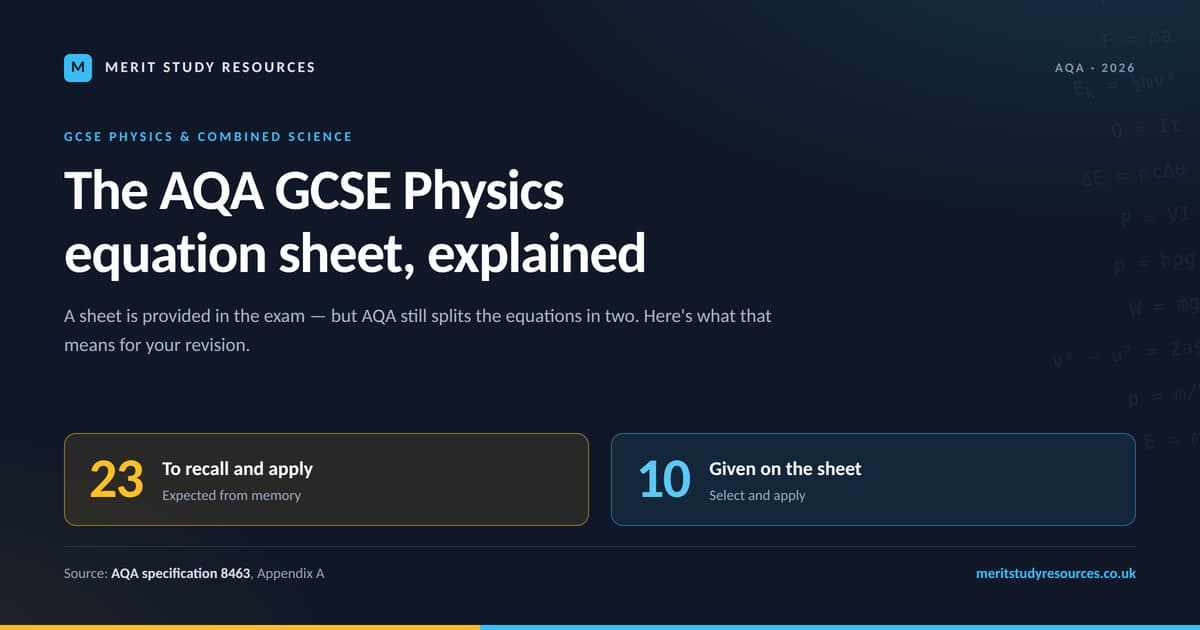
Yes — an equation sheet is provided in AQA GCSE Physics and Combined Science exams in 2026. But AQA's specification still splits the equations into two groups: 23 you are expected to recall and apply, and 10 you select and apply from the sheet. And Ofqual requires exam boards to avoid setting questions that can be answered just by copying from it. The sheet removes the memory test. It does not remove the physics.
Is there an equation sheet in the 2026 AQA GCSE Physics exam?
Yes. A clean copy is provided with your paper — you do not need to bring anything.
The arrangement began as a pandemic-era support measure and has been extended repeatedly. Ofqual consulted on continuing formulae and equation sheets for GCSE maths, physics and combined science in 2025, 2026 and 2027, and has since decided to keep them for the remaining lifetime of the current specifications from 2028 onwards, including resits. AQA published its arrangements for 2027 and 2028 onwards on 1 September 2026.
Under that decision, exam boards must publish the sheets by 1 September of the year before the exams, supply clean copies with the papers, and — this is the part worth reading twice — avoid setting questions that can be answered solely by copying from the sheets.
So there is no cliff edge coming, and no reason to panic about a rule change mid-course. But there is also no version of this where the sheet answers the question for you.
What AQA's specification actually says
Appendix A of the AQA GCSE Physics specification (8463) divides the equations into two groups, and the wording is precise.
Group 1 — recall and apply. AQA's phrasing: "In solving quantitative problems, students should be able to recall and apply the following equations, using standard SI units." There are 23 of them.
Group 2 — select and apply. AQA's phrasing: "Students should be able to select and apply the following equations from the Physics equation sheet." There are 10.
This split is the specification's baseline, and it tells you where AQA thinks the difficulty lies. The 23 in Group 1 are the everyday tools of GCSE physics — the ones you will use in almost every calculation question across the course. The 10 in Group 2 are the ones with awkward symbols or specific contexts, where the point of the question is applying them, not remembering them.
The 23 equations AQA expects you to recall
Grouped by topic, which is how they are worth learning.
Forces and motion
|
Equation |
In words |
|
W = mg |
weight = mass × gravitational field strength |
|
W = Fs |
work done = force × distance moved along the line of action |
|
F = ke |
force on a spring = spring constant × extension |
|
M = Fd |
moment of a force = force × distance to pivot |
|
p = F/A |
pressure = force normal to a surface ÷ area |
|
s = vt |
distance travelled = speed × time |
|
a = Δv/t |
acceleration = change in velocity ÷ time |
|
F = ma |
resultant force = mass × acceleration |
|
p = mv (HT) |
momentum = mass × velocity |
Energy and power
|
Equation |
In words |
|
Eₖ = ½mv² |
kinetic energy = ½ × mass × speed² |
|
Eₚ = mgh |
gravitational potential energy = mass × g × height |
|
P = E/t |
power = energy transferred ÷ time |
|
P = W/t |
power = work done ÷ time |
|
efficiency = useful output energy ÷ total input energy |
|
|
efficiency = useful power output ÷ total power input |
Electricity
|
Equation |
In words |
|
Q = It |
charge flow = current × time |
|
V = IR |
potential difference = current × resistance |
|
P = VI |
power = potential difference × current |
|
P = I²R |
power = current² × resistance |
|
E = Pt |
energy transferred = power × time |
|
E = QV |
energy transferred = charge flow × potential difference |
Waves and matter
|
Equation |
In words |
|
v = fλ |
wave speed = frequency × wavelength |
|
ρ = m/V |
density = mass ÷ volume |
The 10 equations given on the sheet
|
Equation |
In words |
|
p = hρg (HT) |
pressure due to a column of liquid = height × density × g |
|
v² − u² = 2as |
(final velocity)² − (initial velocity)² = 2 × acceleration × distance |
|
F = mΔv/Δt (HT) |
force = change in momentum ÷ time |
|
Eₑ = ½ke² |
elastic potential energy = ½ × spring constant × extension² |
|
ΔE = mcΔθ |
change in thermal energy = mass × specific heat capacity × temperature change |
|
E = mL |
thermal energy for a change of state = mass × specific latent heat |
|
T = 1/f |
period = 1 ÷ frequency |
|
magnification = image height ÷ object height |
|
|
F = BIl (HT) |
force on a conductor = magnetic flux density × current × length |
|
transformer equations (HT) |
relating potential difference, current and turns in primary and secondary coils |
(HT) marks Higher Tier only. This follows AQA's Appendix A: Physics equations — check it directly for the definitive list and the exact Higher Tier markings for your specification.
Why having the sheet is not the same as knowing the equations
Three things separate a student who has the sheet from one who can use it, and all three cost marks.
Choosing the right equation. A question about a kettle heating water gives you a mass, a temperature change and a time. Do you reach for ΔE = mcΔθ, or P = E/t, or both in sequence? The sheet lists equations; it does not tell you which one this question wants. Recognising that is the physics, and it is what Ofqual's rule about not setting copy-the-sheet questions is designed to preserve.
Rearranging it. Examiners rarely ask for the subject of the equation as written. You are given the energy and asked for the mass; given the power and asked for the time. Rearranging under pressure, correctly, is a skill that only comes from practice — and a printed equation does nothing for it.
Units. Marks are lost here more than anywhere else in GCSE physics. Specific heat capacity in J/kg°C with a mass given in grams. Wave speed in m/s with a wavelength in centimetres. A time in minutes when the equation needs seconds. The sheet gives you the relationship, never the conversion.
The honest way to think about it: the sheet has removed a memory test that was never really the point. What remains — selecting, rearranging, converting, sanity-checking — is the whole of what physics calculation questions have always been testing.
If you take Combined Science instead
Combined Science: Trilogy students use a subset of the same equations. The topics are narrower and some Higher Tier content does not appear, but the structure is identical: an equation sheet is provided, and the specification still separates equations you should recall from equations you select.
Work from the equation list in your own specification rather than the full separate-Physics list, or you will spend time learning equations you will never be asked about.
How to learn the 23 without drowning
Learn them in topic groups, not as a list of 23. The electricity equations connect: Q = It, V = IR, P = VI, E = Pt, E = QV. Learn them as a family that describes one circuit and they reinforce each other. Learned as items 17 to 22 on an alphabetical list, they don't.
Say what each one means in words. If you can state "power is the energy transferred each second" you will never mix up P = E/t and E = Pt, because you understand the relationship rather than the letters.
Test yourself by writing them from blank. Reading a list creates a feeling of familiarity that disappears in an exam hall. Writing the electricity equations from memory on blank paper, then checking, is worth ten times as much as rereading them.
Do calculation questions, not equation drills. The skill being assessed is application. Work through past paper calculation questions with the equation sheet next to you, exactly as it will be in the exam, and you train selection and rearrangement at the same time as recall.
Keep a units log. Every time a question catches you with grams instead of kilograms, write it down. After a dozen papers you will have a personal list of the conversions that trip you specifically, which is far more useful than a generic list.
Practise with past papers
The equation sheet only becomes second nature through calculation questions under timed conditions.
If you are taking A-Level Maths or Physics alongside, the same "know your reference document" principle applies — see our guides to the Edexcel A-Level Maths formula booklet and the SUVAT equations. And check the 2026 GCSE exam timetable so you know how much time you have.
Sitting GCSE Physics as a private candidate or a resit
Not everyone taking this exam is in a school. Home-educated students, adult learners returning to study, and anyone resitting after results day needs a registered exam centre to enter them — schools cannot usually accept external candidates, and entry deadlines fall months before the exam itself.
If you are in London, Exam Centre London is a private exam centre that accepts private candidates for GCSE, IGCSE, A-Level and Functional Skills, including practical endorsements for the sciences. Wherever you are, register early — late entry fees rise steeply and some subjects close earlier than others.
Frequently asked questions
Is there an equation sheet in GCSE Physics 2026? Yes. AQA provides a clean copy of the Physics equation sheet with the exam paper for GCSE Physics and Combined Science in 2026.
Do I still need to memorise physics equations? AQA's specification lists 23 equations students should be able to recall and apply, and 10 to select from the sheet. Even where a sheet is provided, questions are set so that they cannot be answered by copying from it — you still need to choose the right equation, rearrange it and handle units.
Will the equation sheet be removed? No. Ofqual has decided to continue providing formulae and equation sheets for GCSE maths, physics and combined science for the remaining lifetime of the current specifications, from 2028 onwards, including resits.
How many equations are on the AQA GCSE Physics equation sheet? AQA's specification identifies 10 equations that students select and apply from the sheet, alongside 23 they are expected to recall.
Is the equation sheet the same for Combined Science? Combined Science uses a subset of the separate Physics equations. Work from the equation list in your own specification.
Where can I download the AQA GCSE Physics equation sheet? From AQA's own assessment resources for GCSE Physics 8463. Exam boards must publish the sheet by 1 September of the year before the exams.
What's the difference between the equation sheet and the data sheet? At GCSE, physics uses an equation sheet. "Data sheet" usually refers to A-Level Physics, which provides constants and formulae, or to the Chemistry data sheet with the periodic table.