GCSE Maths past papers are one of the best ways to prepare for exams, but many students use them in a way that limits their progress. They complete a full paper, mark it, feel happy or disappointed with the score, and then move on to the next one. The problem is that this approach often shows weaknesses without fixing them.
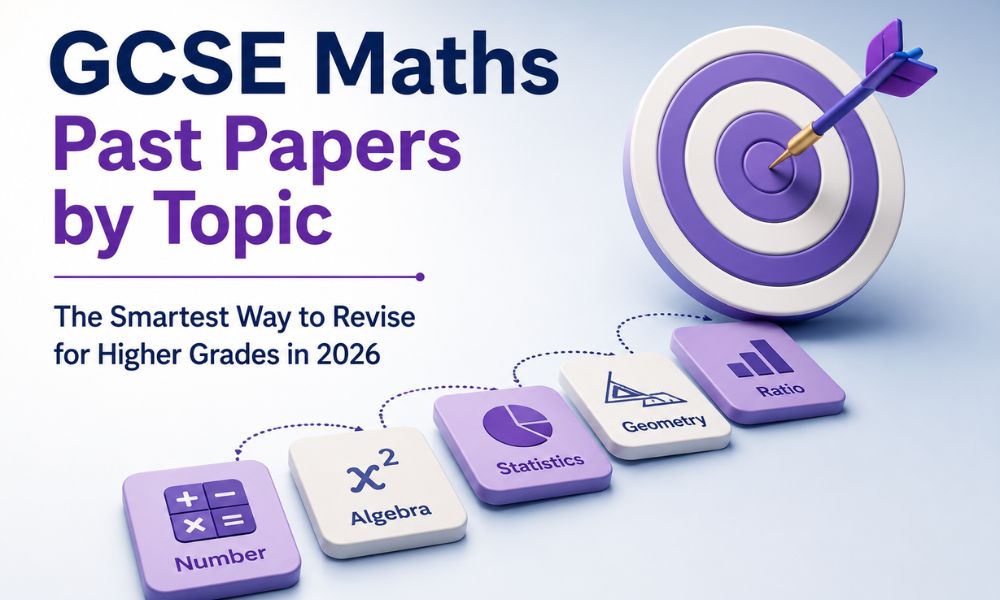
That is where GCSE Maths past papers by topic become so useful. Instead of practising a full paper from start to finish, students focus on one topic at a time: algebra, ratio, probability, graphs, geometry, trigonometry, statistics or number skills. This makes revision more targeted, more efficient and often much more effective for improving grades.
At Merit Study Resources, students, parents and tutors can find past papers and revision materials designed to make exam preparation more organised. If your goal is to improve GCSE Maths results, topic-based past paper practice should be part of your revision plan.
What Does "Past Papers by Topic" Mean?
Past papers by topic means taking real exam-style questions and organising them by the skill being tested. Instead of completing Paper 1, Paper 2 or Paper 3 in order, a student might practise 20 ratio questions from different years, then 20 algebra questions, then a set of geometry problems.
This approach is different from ordinary worksheets because the questions are closer to real exam style. They show how exam boards ask the same topic in different ways. A student may understand a basic percentage question but struggle when percentages are mixed with reverse calculations, compound interest or ratio. Topic-based past paper practice reveals those patterns.
For GCSE Maths, this is especially powerful because topics are connected. Weakness in fractions can affect ratio, probability, algebra and standard form. Weakness in equations can affect graphs, simultaneous equations and problem-solving. Practising by topic helps students strengthen the building blocks before attempting full exam papers again.
Why Topic Practice Helps Students Improve Faster
Full past papers are excellent for timing and exam stamina, but they are not always the best first step for fixing weak areas. If a student keeps losing marks on algebra, doing another full paper may only give them a few algebra questions. That is not enough repetition to build confidence.
Topic practice gives focused repetition. Students can see several versions of the same idea, compare methods and learn how the topic changes from easy questions to harder ones. This is how understanding becomes more secure.
It also makes revision feel less overwhelming. Instead of thinking, "I am bad at Maths," the student can identify a specific problem: "I need to improve expanding brackets," or "I need more practice with bearings." Specific problems are much easier to solve than general frustration.
Foundation and Higher: Use the Right Topic Questions
GCSE Maths students usually sit Foundation or Higher tier, so the topic practice should match the student's level and target grade.
Foundation students should focus on secure accuracy. Important areas include arithmetic, fractions, decimals, percentages, ratio, basic algebra, angles, area, volume, probability, averages and graphs. For Foundation revision, the aim is to build confidence and reduce avoidable mistakes. Topic questions help students practise the same skill enough times for it to become reliable.
Higher students need both strong basics and more advanced problem-solving. Higher tier topic practice may include surds, bounds, circle theorems, vectors, quadratic equations, simultaneous equations, algebraic proof, trigonometry, histograms and cumulative frequency. Students aiming for grades 7, 8 or 9 need to practise topics in mixed and unfamiliar forms, not just textbook examples.
The best revision plan does not jump straight to the hardest questions. It builds from secure method to exam-level application.
The Best GCSE Maths Topics to Revise by Past Paper Questions
Some Maths topics appear again and again across exam papers, so they are worth targeted practice. Number topics such as fractions, percentages, ratio and standard form are important because they connect to so many other areas. Algebra topics such as solving equations, expanding brackets, factorising, sequences and graphs are also high value.
Geometry and measures deserve regular practice too. Angles, bearings, transformations, area, volume, Pythagoras and trigonometry often appear in multi-step questions. Statistics and probability can also cost students marks because questions may involve interpreting tables, charts, averages, cumulative frequency, histograms or probability trees.
Rather than trying to revise every topic equally, students should begin with the topics where they lose the most marks. A mistake log can help. After each paper or worksheet, write down the topic, the mistake and the correct method. After a few sessions, patterns will become obvious.
Full Papers vs Topic Questions
Students often ask whether they should revise with full past papers or topic questions. The answer is both, but at different times and for different reasons.
Topic questions are best when learning, repairing or strengthening a specific area. If you cannot solve simultaneous equations confidently, do not wait for them to appear in a full paper. Practise that topic directly until the method feels natural.
Full papers are best for timing, stamina and mixed-topic decision-making. In the real exam, questions are not labelled by topic. Students need to decide which method to use. That skill comes from full paper practice.
A smart weekly routine could include two topic sessions and one timed paper section. For example, Monday could be algebra topic questions, Wednesday could be geometry topic questions, and Saturday could be a timed section from a full paper. This gives students both focused repair and exam practice.
How to Use Mark Schemes Properly
Mark schemes are not just answer sheets. They show how marks are awarded, including method marks, accuracy marks and acceptable working. This matters in GCSE Maths because a student can sometimes gain marks even when the final answer is wrong.
When using topic questions, students should mark carefully and compare their working with the mark scheme. If the answer is wrong, the next question should be: why? Was it a calculation error, a method error, a missed formula or a misunderstanding of the question?
Official sources such as AQA past papers and mark schemes, Pearson Edexcel past papers and the OCR past paper finder are useful for checking original papers and mark schemes.
A Simple Topic-Based Revision Method
A simple method works best. Start with one topic that needs improvement. Complete a short set of questions without looking at the answers. Mark the work honestly. Write down every mistake. Then redo the incorrect questions a few days later.
Once the topic improves, move to a harder set or mix it with related topics. For example, after practising basic ratio, move to ratio with fractions, proportion, similar shapes or problem-solving. After practising linear equations, move to simultaneous equations or graphs.
The key is not to rush. Students often want to move on quickly, but Maths improves through repeated correct practice. A topic is not secure just because one question was answered correctly. It is secure when the student can answer different versions of the question under time pressure.
How Tutors and Parents Can Use Topic Questions
Topic-based past paper questions are useful for tutors because they show exactly what a student needs next. If a student struggles with several probability questions, the tutor can reteach probability instead of guessing. If the student handles Foundation questions well, the tutor can introduce Higher-style extensions.
Parents can also support without being Maths experts. They can help by encouraging regular practice, checking that answers are marked and asking the student to keep a mistake log. The parent does not need to teach every method; they just need to help the student stay consistent.
For tuition centres and schools, topic packs can be used for homework, intervention groups, revision sessions and exam preparation classes. They make it easier to target specific gaps and measure progress over time.
Common Mistakes to Avoid
One mistake is only practising favourite topics. Students often revise what they already understand because it feels good. Higher grades come from fixing weaker areas, not repeating comfortable ones.
Another mistake is using topic questions without returning to full papers. Topic practice builds skill, but full papers build exam performance. Both are needed.
Students should also avoid ignoring written working. In Maths, clear working is part of the answer. It helps examiners award method marks and helps students spot mistakes when reviewing.
Finally, do not leave topic practice until the last few days before the exam. It works best when used regularly over several weeks.
Find GCSE Maths Past Papers and Revision Resources
If you are revising for GCSE Maths, use full papers and topic practice together. Start with weak topics, build confidence through focused questions, then return to timed papers to test progress.
Merit Study Resources provides a growing library of past papers, revision materials and study support for GCSE, IGCSE and A-Level students. You can also read our guide to GCSE Maths past papers and our GCSE past papers with mark schemes guide to build a stronger revision routine.
GCSE Maths improvement does not come from doing random papers and hoping for the best. It comes from finding weak topics, practising them properly and learning from mistakes. Topic-by-topic past paper revision is one of the smartest ways to do that.
FAQs
What are GCSE Maths past papers by topic?
GCSE Maths past papers by topic are exam-style questions organised by skill area, such as algebra, ratio, geometry, probability or statistics, instead of by full exam paper.
Are topic questions better than full past papers?
Topic questions and full papers do different jobs. Topic questions are best for fixing weak areas, while full papers are best for timing, stamina and mixed exam practice.
Should Higher tier students use topic-based past papers?
Yes. Higher tier students can use topic-based past papers to practise advanced areas such as circle theorems, vectors, surds, bounds, trigonometry and algebraic proof.
How often should I practise GCSE Maths topic questions?
Most students benefit from two or three focused topic sessions per week, combined with regular full-paper practice as exams get closer.
Do I need mark schemes for topic questions?
Yes. Mark schemes help students check answers, understand method marks and learn how examiners award credit.