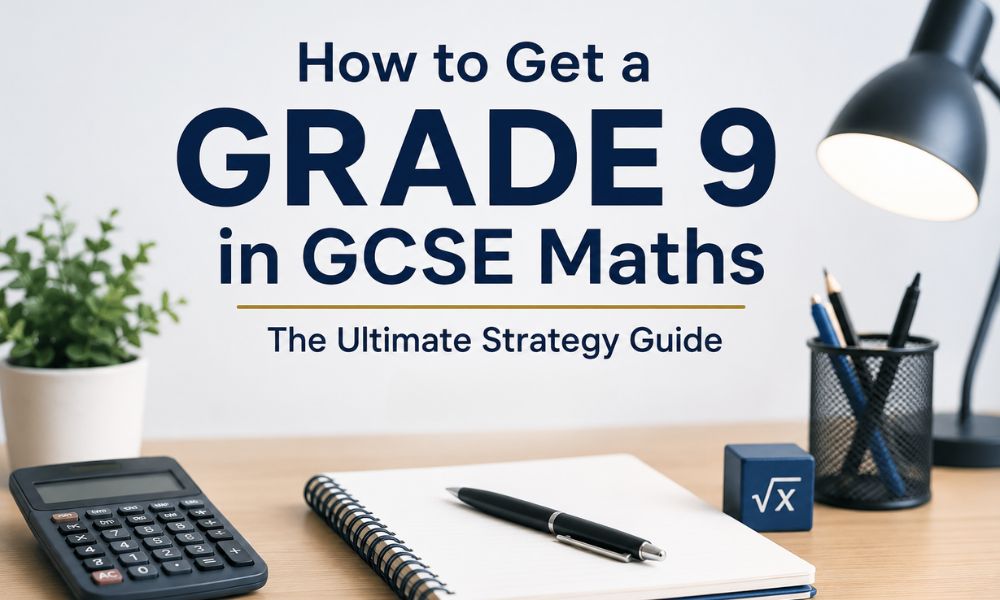
Achieving a Grade 9 in GCSE Maths requires more than memorising formulas. Students who consistently achieve the highest grades master problem-solving techniques, practise timed past papers, maintain an error log, and show clear working to maximise method marks.
Achieving a Grade 9 in GCSE Maths is the academic equivalent of winning a gold medal. It places you in the top 3-5% of students nationwide and instantly signals to elite sixth forms and universities that you possess exceptional analytical and problem-solving skills.
However, the leap from a comfortable Grade 7 to an elusive Grade 9 is massive. The exam boards (whether AQA, Edexcel, or OCR) intentionally design the final questions on the Higher Tier papers to be deeply unfamiliar and complex. You cannot simply memorize formulas to get a 9; you must understand how to apply them to scenarios you have never seen before.
At Merit Study Resources, we have analyzed thousands of past papers and examiner reports. Based on our research into what separates the top students from the rest, we have created this definitive 2026 strategy guide.
Understanding the Grade 9 Philosophy: Method over Memory
Many students approach Maths like they approach History: they try to memorize everything. While you do need to memorize certain formulas (like the quadratic formula, sine rule, and cosine rule), a Grade 9 is won in the application.
When an examiner marks a paper, they are explicitly instructed to award method marks (often denoted as 'M1' on mark schemes). Even if you make a silly arithmetic error on the final line, you can still gain 4 out of 5 marks on a complex question just for showing the correct algebraic setup.
Grade 9 Strategy: Never do working out 'in your head'. Treat every multi-mark question as a story you are telling the examiner. Lay out your algebra line by line, aligning your equals signs. If the examiner can easily follow your logic, they will find excuses to give you marks.
How to Tackle the Dreaded 5-Mark Problem-Solving Questions
The final five questions on a Higher Tier paper are designed to separate the 7s and 8s from the 9s. These are usually unstructured, multi-topic problem-solving questions. For example, a single question might combine circle theorems, trigonometry, and simultaneous equations.
Here is the exact framework to tackle them:
-
Extract the Data: Read the question with a highlighter. Highlight every number, ratio, and mathematical keyword (e.g., "tangent", "regular polygon", "perpendicular").
-
Jot Down the Relevant Rules: Before trying to solve it, write down the formulas related to the keywords. If it mentions a tangent, write down "Radius meets tangent at 90°".
-
Find the First Step, Not the Answer: Do not try to see the whole path to the final answer immediately. Just find one thing you can calculate with the data given. Calculating that one thing often unlocks the next step.
To master this, you need relentless practice. Our Worksheets and Booklets are specifically categorized by difficulty, allowing you to focus entirely on these "Grade 8/9" level questions.
The Power of the Topic-by-Topic Error Log
If you take a past paper, score 65%, check the mark scheme, and then immediately move on to the next past paper, you are wasting your time. You will simply make the exact same mistakes on the next paper.
To achieve a Grade 9, you must embrace your mistakes through an Error Log.
How to Create an Error Log:
-
Get a dedicated notebook.
-
Every time you get a question wrong on a worksheet or past paper, write down the specific topic (e.g., "Completing the Square" or "3D Pythagoras").
-
Write down why you got it wrong. Was it a silly arithmetic error? Did you misread the question? Did you completely forget the formula?
-
Once a week, review this log.
If you notice "Vectors" appearing three times in your log, you must stop doing full past papers and spend an entire evening just doing Vectors Worksheets. You must plug the hole in the bucket before pouring more water in.
When and How to Use Full Past Papers
Past papers are the gold standard of revision, but timing is everything.
-
September to February: Focus on topic-by-topic revision. If your teacher is covering Algebra, use our targeted worksheets to master it.
-
March onwards: This is when you transition to full GCSE Past Papers.
The Golden Rule of Past Papers: You must do them under strict exam conditions. No music, no phone, no notes, and a strict time limit. If the paper is 1 hour and 30 minutes, stop writing at exactly that time. Use a different colored pen to finish the questions you missed. This trains your time management—a crucial skill, as many students miss out on a Grade 9 simply because they ran out of time on the last page.
(For the official past papers and specifications, always cross-reference with your specific exam board, whether Edexcel or AQA).
Common Pitfalls That Cost You the Top Grade
Even the brightest students make predictable errors under pressure. Avoid these classic pitfalls:
-
Rounding Too Early: Never round your numbers in the middle of a calculation. Keep the long decimal on your calculator display or use fractions/surds. Only round to the requested significant figures on the very final line.
-
Ignoring Units: If a question gives dimensions in centimeters but asks for an answer in cubic meters, convert the units before you start calculating volume.
-
Not Checking the Scale: On graphs or histograms, never assume one small square equals one unit. Always calculate the scale of the axes carefully.
-
"Show That" Questions: If a question asks you to "Show that x = 4", you cannot use x = 4 in your working out to prove it. You must start from the beginning and arrive at 4 as your conclusion.
Exam Day Checklist for GCSE Maths
The night before the exam is not for learning new topics; it is for organizing your mind and your equipment.
Your Clear Pencil Case Must Include:
-
3x Black ballpoint pens (Do not use gel pens; they may not scan properly)
-
2x HB Pencils (Sharp)
-
A good quality eraser and sharpener
-
A 30cm clear ruler
-
A geometry set (Compass and Protractor)
-
A scientific calculator (Make sure it is in 'Degrees' mode, not 'Radians'!)
Frequently Asked Questions (FAQs)
Q: What percentage do you need for a Grade 9 in GCSE Maths?
A: While grade boundaries fluctuate yearly based on difficulty, you typically need to score between 80% and 85% across all three papers to secure a Grade 9 in the Higher Tier.
Q: Can I get a Grade 9 if I take the Foundation Tier?
A: No. The highest grade achievable on a Foundation Tier paper is a Grade 5. To achieve a Grade 9, you must be entered for the Higher Tier.
Q: How many hours a week should I revise for GCSE Maths?
A: Quality beats quantity. Aim for 3 to 4 hours of focused, active revision per week specifically for Maths, ideally broken down into 30-45 minute daily blocks of intensive problem-solving.
Q: Are past papers enough to get a Grade 9?
A: Past papers are crucial, but they are not enough on their own. You must use them in conjunction with an Error Log to actively target and fix the specific topics you are losing marks on.
Q: Which exam board is the hardest for Maths?
A: Officially, Ofqual ensures that a Grade 9 on Edexcel is exactly as difficult to achieve as a Grade 9 on AQA or OCR. However, the style of questions varies; Edexcel is known for highly wordy problem-solving questions at the end of the paper.
Start Your Journey to a Grade 9 Today
Achieving a Grade 9 is not about natural genius; it is about strategy, consistency, and having access to the right resources.
At Merit Study Resources, we provide the exact tools high-achieving students use to dominate their exams.
✔ Targeted Grade 8/9 Worksheets ✔ Comprehensive Topic Booklets ✔ Full Past Papers & Mark Schemes ✔ Affordable access for all students
Don't wait until the mock exams to realize you have knowledge gaps. Explore our Pricing plans or browse our All Products page today and secure the resources you need to achieve top marks in 2026.