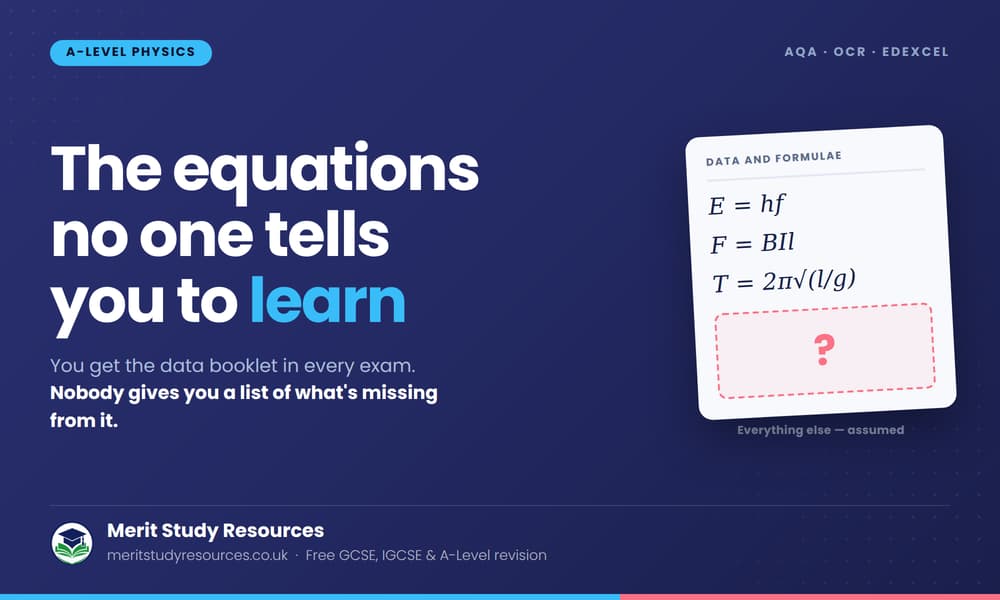
Every A-Level physics exam comes with a data and formulae booklet — you do not have to memorise the constants or the harder equations. But the booklet does not contain everything, and unlike at GCSE, your exam board does not publish a list of what you still need to know. This guide covers what is actually in the AQA booklet, what typically is not, and how to find your own gaps before the exam finds them for you.
You get the booklet in every exam — and always have
Worth clearing up first, because A-Level and GCSE physics work differently and students conflate them.
At GCSE, the equation sheet arrived as a support measure during the pandemic and has been extended by Ofqual since. At A-Level, the data and formulae booklet is not a concession at all — it is a permanent part of the assessment design and always has been. A clean copy is supplied with every paper. You do not bring your own, and you do not need to.
The AQA version is titled "A-level Physics data and formulae", and the copy currently in use is marked "For use in exams from the June 2017 Series onwards" — the same booklet across the whole current specification.
This changes what the exam is testing. It is not testing whether you can remember the Stefan constant. It is testing whether you can pick the right relationship and use it.
What is actually in the AQA booklet
Here is the structure of AQA's booklet for Physics 7407/7408, section by section.
Data
-
Fundamental constants and values — the speed of light, the Planck constant, the gravitational constant, elementary charge, particle masses and the rest
-
Astronomical data — masses and radii of the Sun, Earth and Moon
Formulae, grouped by topic
|
Topic |
Topic |
|
Particle physics |
Circular motion |
|
Waves |
Simple harmonic motion |
|
Mechanics |
Thermal physics |
|
Materials |
Gravitational fields |
|
Electricity |
Electric fields and capacitors |
|
Nuclear physics |
Magnetic fields |
Optional topics — formulae for each of the A-Level options are included too: astrophysics, medical physics, engineering physics, turning points in physics, and electronics.
That is a substantial document. Most of the second-year field and oscillation content — the equations students find hardest to recall — is printed for you.
What is not in it, and why AQA will not tell you
Here is the part that catches people out, and it is worth being precise about it.
AQA does not publish a "must memorise" list for A-Level physics.
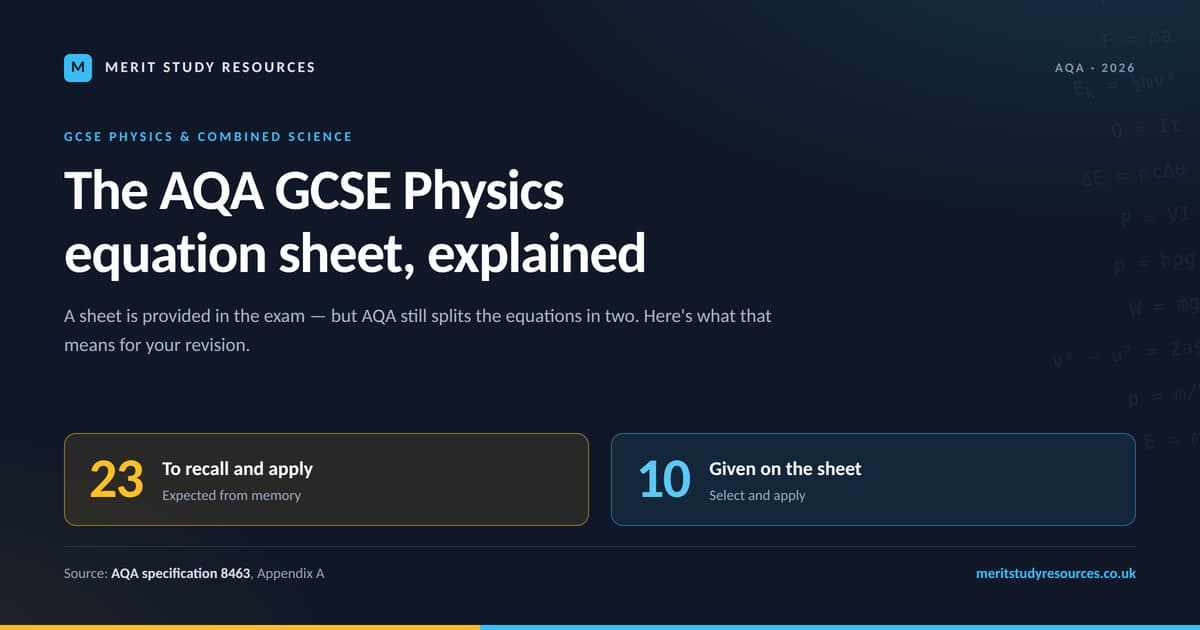
At GCSE it does. The GCSE specification has an appendix splitting equations into two explicit groups: 23 that students must recall and apply, and 10 they select and apply from the sheet. Students know exactly where they stand.
At A-Level there is no equivalent. The booklet contains a selected set — broadly, the constants and the relationships that are harder to derive or remember — and everything outside it is treated as assumed knowledge. No list, no appendix, no official statement of what falls on which side.
What is generally left out is the foundational material: basic definitions of physical quantities, the core mechanics relationships, and the simpler electricity and waves equations. The reasoning is that if you have done the course, these should be as automatic as arithmetic. That is a fair assumption for most students and a nasty surprise for the ones it is not true of.
So the honest answer to "which equations do I need to learn?" is that you have to work it out. Anyone who hands you a confident list has either copied it from another site or made it up. What follows is how to build your own, which takes an afternoon and is worth far more than someone else's list.
How to find your own gaps in one afternoon
This method is simple, slightly tedious, and the single most useful thing you can do with the booklet.
1. Print the booklet. Download it from your exam board and print it. You need it physically next to you, not in another browser tab.
2. Work through a past paper with it open. Do the paper properly, under timed conditions if you can, with the booklet beside you exactly as it will be in the exam.
3. Every time you reach for an equation, check whether it is in the booklet. If it is, note where — which page, which section. If it is not, write it on a separate sheet.
4. Repeat for three or four papers. By the end, that separate sheet is your personal must-memorise list. It is specific to your board, your specification and the topics that actually come up.
5. Learn that sheet, not a generic one. It will be far shorter than any list you could find online, and every item on it is something a real paper actually asked for.
The by-product matters as much as the list. After three papers you will know the booklet's layout well enough to find anything in seconds, which is the other half of the problem.
The boards are not the same
If you have downloaded a formula sheet from a revision site, check whose it is. The booklets differ in content, layout and name:
|
Board |
Document |
|
AQA (7407/7408) |
A-level Physics data and formulae |
|
OCR (H156/H556) |
Data, Formulae and Relationships Booklet |
|
Pearson Edexcel |
Data, Formulae and Relationships |
|
WJEC / Eduqas |
Own data booklet |
|
CIE / Cambridge International (9702) |
Own data and formulae sheet |
A CIE data sheet is not an AQA booklet. This matters most for students revising from material found online, where the top search results include booklets from at least four different boards without much labelling. Always work from the one your own centre will hand you.
Three ways students lose marks with the booklet in front of them
Hunting instead of knowing. A student who does not know the booklet's layout spends thirty seconds per lookup finding a page. Over a two-hour paper that is real time taken from the questions that need thinking. Students who know roughly where each section sits recover that time entirely.
Picking a plausible equation instead of the right one. The booklet gives you options, and a question about a charged particle in a field will have several relationships that look applicable. Choosing between them is the physics. The booklet does not help with this at all — arguably it makes it harder, because it puts every tempting alternative on the page.
Assuming something is there when it is not. This is the expensive one. A student who has never checked reaches for a basic mechanics relationship mid-exam, cannot find it, and loses composure as well as time. Working through past papers with the booklet open eliminates this entirely.
What the booklet is not testing
It is worth saying plainly, because it changes how you should revise.
Since the constants and harder relationships are given, the marks sit almost entirely elsewhere: in selecting the right relationship, rearranging it correctly, handling units and prefixes, and knowing the conditions under which a relationship applies. That last one is the most commonly overlooked — plenty of the equations in the booklet only hold under particular assumptions, and the booklet does not print the assumptions.
Which means: revising by copying equations out is close to useless at A-Level. Revising by doing calculation questions with the booklet open is the thing that moves grades.
Practise with past papers
Work through papers with the booklet beside you — that is the whole method above.
-
AQA A-Level Physics past papers — 64 papers with mark schemes, June 2017 to June 2024
Related guides worth reading alongside this one:
-
Mastering SUVAT equations — the core mechanics relationships, worked through
-
Edexcel A-Level Maths formula booklet: complete guide — the same exercise for maths
-
The AQA GCSE Physics equation sheet, explained — how the GCSE version differs, and why it has an explicit list
Frequently asked questions
Do you get a formula sheet in A-Level physics?
Yes. A data and formulae booklet is provided with every A-Level physics paper. It is a permanent part of the assessment, not a temporary concession.
What is in the AQA A-Level physics data booklet?
Fundamental constants, astronomical data, and formulae grouped by topic — particle physics, waves, mechanics, materials, electricity, circular motion, simple harmonic motion, thermal physics, gravitational fields, electric fields and capacitors, magnetic fields and nuclear physics — plus formulae for the optional topics.
Which A-Level physics equations do I have to memorise?
AQA does not publish a list. The booklet contains the constants and the harder relationships; the foundational definitions and core mechanics and electricity equations are generally assumed. The reliable way to find your own gaps is to work through past papers with the booklet open and note every equation you needed that was not printed in it.
Is the A-Level physics formula sheet the same for every exam board?
No. AQA, OCR, Edexcel, WJEC and CIE each issue their own booklet, and the contents differ. Use the one for your specification.
Can I bring my own formula sheet into the exam?
No. A clean copy is supplied with the paper. You cannot bring annotated or alternative material into the exam hall.
Where can I download the A-Level physics formula sheet?
From your exam board's website — AQA, OCR, Pearson Edexcel, WJEC and Cambridge International all publish theirs as a free PDF. Make sure you download the one matching your specification code.