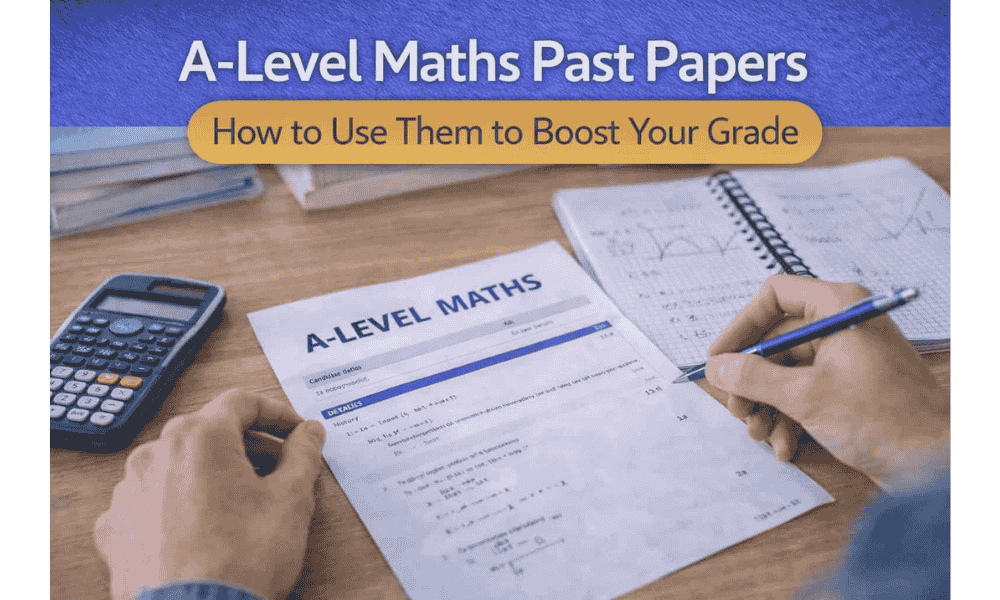
A-Level Maths is one of the most challenging subjects for many students. Even those who understand the topics often struggle in exams because of time pressure, weak problem-solving steps, or small calculation mistakes.
From our experience working with A-Level students, one thing makes the biggest difference to results: regular, structured practice using A-Level Maths past papers.
Past papers do more than test your knowledge. They teach you how questions are asked, how marks are awarded, and how to perform under real exam conditions.
This guide explains how to use A-Level Maths past papers effectively to improve your confidence and boost your final grade.
Why A-Level Maths Past Papers Are So Important
Students who practise A-Level Maths past papers regularly are more likely to:
-
Understand exam-style questions
-
Improve speed and accuracy
-
Learn where method marks are given
-
Reduce careless mistakes
-
Stay calm during exams
In A-Level Maths, marks are often awarded for working and reasoning, not just final answers. Past papers train you to show your thinking clearly.
What Is Included in A-Level Maths Past Papers?
Most A-Level Maths past papers include:
By practising these papers, you learn:
-
How long to spend on each question
-
Which topics appear most frequently
-
When to move on and return later
This helps you manage your time more effectively in real exams.
A-Level Maths Past Papers by Exam Board
Different exam boards use slightly different styles and formats. Although the syllabus is similar, question wording and mark schemes can vary.
Common A-Level Maths exam boards include:
You should always practise past papers that match your registered exam board. This helps you become familiar with layout, language, and marking criteria.
How to Use A-Level Maths Past Papers Properly
Simply downloading papers is not enough. To see real improvement, follow this method.
1. Practise Under Exam Conditions
When attempting a past paper:
-
Work in a quiet room
-
Follow the official time limit
-
Use only approved equipment
-
Avoid checking answers during the paper
This builds exam stamina and concentration.
2. Show All Working Clearly
In A-Level Maths, method marks are very important.
Always:
Even if your final answer is wrong, clear working can still earn marks.
3. Mark Your Work Carefully
After finishing a paper:
This stage is where most learning happens.
4. Fix Weak Topics
Use your past paper results to find:
Then revise those areas before attempting another paper.
Targeted revision is much more effective than revising everything equally.
When Should You Start Using A-Level Maths Past Papers?
The best time to start using past papers is once you understand the main topics.
A typical timeline:
-
February: Topic-based practice
-
March–April: Full past papers
-
May–June: Light revision and review
Many students plan their practice using dates from the A-Level exam timetable 2026 UK.
A-Level Maths Past Papers for Resits & Private Candidates
Past papers are especially useful for:
-
A-Level resit students
-
Private candidates
-
Adult learners
-
Home-educated students
They provide structure when studying independently. Many resit students improve their grades by combining past papers with expert A-Level revision support.
Common Mistakes Students Make
Avoid these mistakes:
-
Practising without timing
-
Ignoring mark schemes
-
Writing only final answers
-
Repeating the same paper too often
-
Not reviewing feedback
Remember: quality practice matters more than quantity.
Final Tips to Improve A-Level Maths Results
A-Level Maths past papers are not just revision tools — they are exam training tools.
Frequently Asked Questions (A-Level Maths Past Papers)
Are A-Level Maths past papers free to use?
Yes. Most A-Level Maths past papers are available online for free and can be used for revision.
How many past papers should I complete?
Fewer papers with full review are more effective than rushing through many without feedback.
Should I practise all modules (Pure, Mechanics, Statistics)?
Yes. You should practise all modules required by your exam board.
Are past papers enough to get a good grade?
Past papers are essential, but combining them with structured revision and guidance gives the best results.
🔗 Helpful Next Steps
Final Advice
Improving in A-Level Maths takes time, patience, and smart practice. If you use past papers properly, review your mistakes, and stay consistent, you can make real progress — even if Maths feels difficult now.
Focus on improvement, not perfection.
Ready to try it? Every paper in the library comes with its mark scheme and a
worked solution, so you can practise without hunting for files.
Find past papers