If you’re a student or parent reviewing AQA results — or checking outcomes after results day — one question continues to come up:
“What are the AQA grade boundaries for 2025, and what do they really mean for my result?”
Grade boundaries can feel confusing, especially when marks don’t translate into grades the way students expect. This complete guide explains AQA Grade Boundaries 2025 in clear, simple terms, helping students and parents understand how grades are awarded, why boundaries change, and how to interpret results correctly.
Note (Updated January 2026)
This guide explains the official AQA Grade Boundaries for the 2025 exam series. Even after results have been released, many students and parents continue to check grade boundaries to understand outcomes, consider reviews of marking, plan resits, or prepare for future exams. This page has been updated to reflect current guidance and common post-results questions.
What Are AQA Grade Boundaries?
AQA grade boundaries are the minimum number of marks required to achieve each grade in an exam. They are set after all exam papers have been marked, not in advance.
AQA determines grade boundaries based on:
-
The difficulty of the exam papers
-
National student performance
-
Maintaining consistent standards across years
Example:
This ensures fairness for all students, regardless of exam difficulty.
When Were AQA Grade Boundaries 2025 Released?
AQA released the official grade boundaries on results day in August 2025, alongside GCSE and A-Level results.
Grade boundaries are never released before results day. Any information seen earlier online is speculation and should not be relied upon.
Subjects Covered in AQA Grade Boundaries 2025
Grade boundaries are published for every AQA subject and paper, including:
GCSE Subjects
-
GCSE Maths
-
GCSE English Language & Literature
-
GCSE Combined Science
-
GCSE Biology, Chemistry & Physics
-
GCSE Geography, History, Psychology and more
A-Level Subjects
-
A-Level Maths
-
A-Level Further Maths
-
A-Level Biology, Chemistry & Physics
-
A-Level Psychology, Sociology, History and others
Each subject has paper-specific boundaries, not just an overall grade.
GCSE AQA Grade Boundaries 2025 Explained
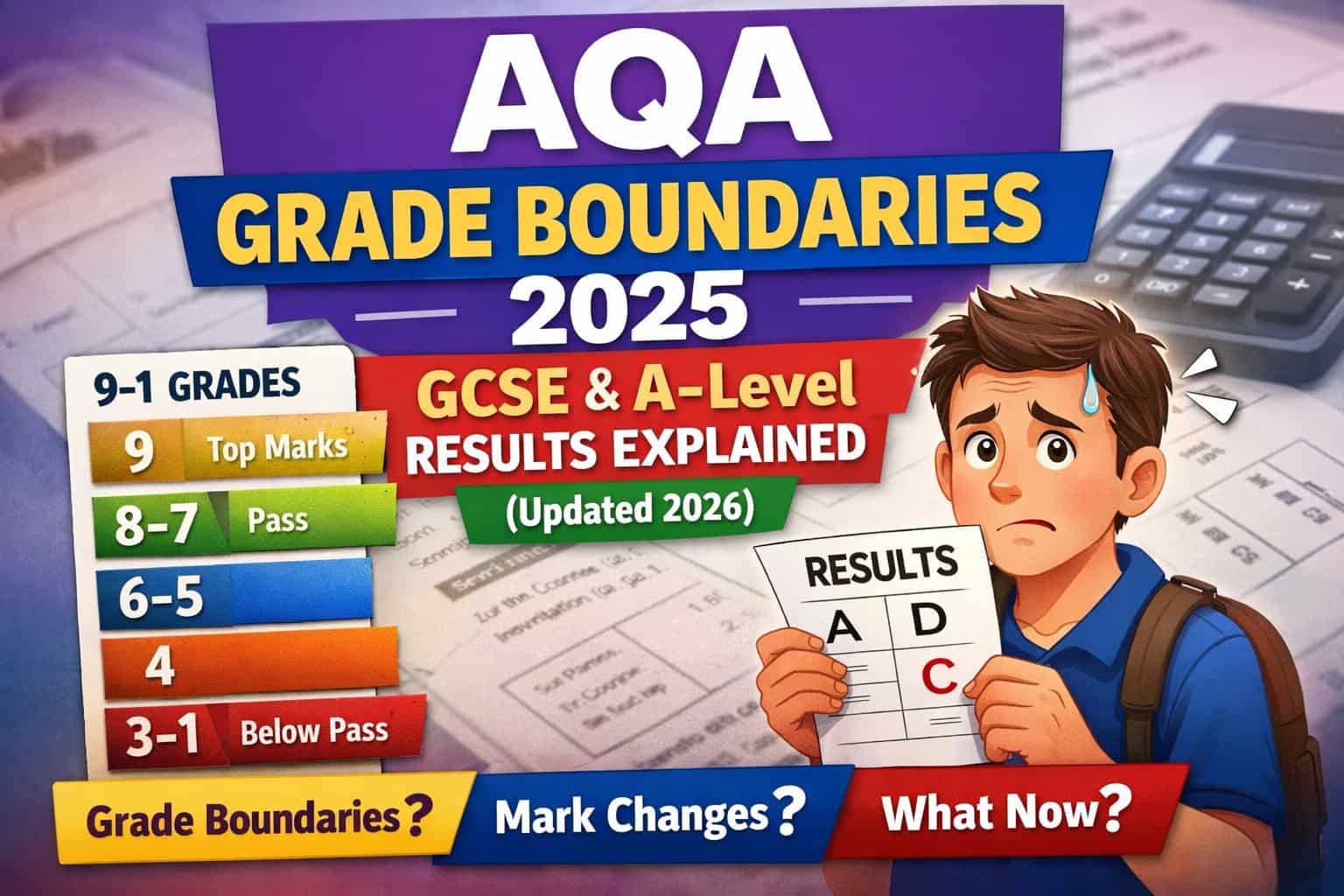
GCSE grades use the 9–1 grading system:
|
GCSE Grade
|
What It Means
|
|
9
|
Exceptional performance
|
|
8–7
|
Very strong understanding
|
|
6–5
|
Good / strong pass
|
|
4
|
Standard pass
|
|
3–1
|
Below pass standard
|
A key point many students miss:
A difference of just 2–5 marks can move a student up or down a GCSE grade, especially near grades 4, 5, and 7.
A-Level AQA Grade Boundaries 2025 Explained
A-Level grades range from A* to E.
Important things to understand:
-
Grade boundaries are set for each paper
-
Marks from all papers are combined
-
Coursework (where applicable) is included
-
A* boundaries are significantly higher than grade A
Lower boundaries do not mean easier marking — marking standards remain consistent.
Why AQA Grade Boundaries Change Every Year
Grade boundaries are not fixed and change each year because:
This is why comparing raw marks across different years can be misleading.
What Should Students Expect from AQA Grade Boundaries 2025?
Based on recent exam cycles:
-
Boundaries were broadly similar to 2024
-
Small subject-specific changes were normal
-
No extreme grade inflation or deflation occurred
Final boundaries depend entirely on student performance in that exam year.
How to Read AQA Grade Boundaries Correctly
To avoid confusion when checking results:
-
Find your exact subject and paper code
-
Compare raw marks, not percentages
-
Check component-level boundaries (Paper 1, Paper 2, etc.)
-
Avoid comparing across different exam boards
-
Remember: grade boundaries explain grades — they do not change marks
AQA Grade Boundaries for Private Candidates
Private candidates are treated exactly the same as school candidates.
✔ Grade boundaries are identical
✔ Marking standards are the same
✔ Results are standardised equally
Private candidates are not disadvantaged in any way.
What If You Are Close to a Grade Boundary?
If you are 1–3 marks away from the next grade, you may consider:
-
Requesting a review of marking
-
Speaking to your exam centre
-
Seeking academic advice before appealing
A small mark change can sometimes make a significant difference, but decisions should be made carefully.
What to Do After Checking AQA Grade Boundaries (2026 Guidance)
Now that the 2025 results cycle has ended, many students are reviewing grade boundaries to decide their next steps. This may include requesting reviews of marking, preparing for resits, or planning subject choices for the next academic year.
Understanding grade boundaries remains important well beyond results day, particularly for students considering appeals or future exam preparation.
Common Myths About AQA Grade Boundaries
❌ “Higher boundaries mean harsher marking”
❌ “Grade boundaries control how many students pass”
❌ “Private candidates have different boundaries”
✔ Grade boundaries exist to ensure fairness, not to limit success.
Final Advice for Students and Parents
Grade boundaries are a statistical tool used to convert marks into grades fairly. They help explain results but do not define ability or future potential.
If results were unexpected, options such as resits, appeals, and targeted academic support are always available.
Frequently Asked Questions About AQA Grade Boundaries
Are AQA grade boundaries released before results day?
No. AQA grade boundaries are released on the same day as results, not before. Any grade boundary information shared online prior to results day is speculative and should not be relied upon.
Can AQA grade boundaries change after results are published?
No. Once AQA officially publishes grade boundaries on results day, they do not change. These boundaries remain fixed for that exam series.
Do grade boundaries affect how exam papers are marked?
No. Exam papers are marked using consistent marking standards. Grade boundaries are applied after marking to convert marks into grades fairly.
Are grade boundaries the same for all exam boards?
No. Each exam board (AQA, Edexcel, OCR) sets its own grade boundaries based on exam difficulty and student performance. Boundaries should never be compared across different boards.
Final Thoughts
Understanding AQA Grade Boundaries 2025 helps students and parents interpret results accurately and plan next steps with confidence. This guide is designed to provide clarity, reassurance, and long-term value — not just raw data.
Whether you are reviewing results or planning ahead, knowing how grade boundaries work puts you in control.
Ready to try it? Every paper in the library comes with its mark scheme and a
worked solution, so you can practise without hunting for files.
Find past papers