Circle theorems come up in almost every GCSE Maths Higher paper, and they're often worth 3–5 marks a question. The good news is that there are only eight rules to learn. Once you can spot them in a diagram and write the right reason, these become some of the most reliable marks on the paper.
This guide explains every circle theorem in plain English, shows the exact wording examiners look for, and walks through worked examples step by step.
The 8 circle theorems are
-
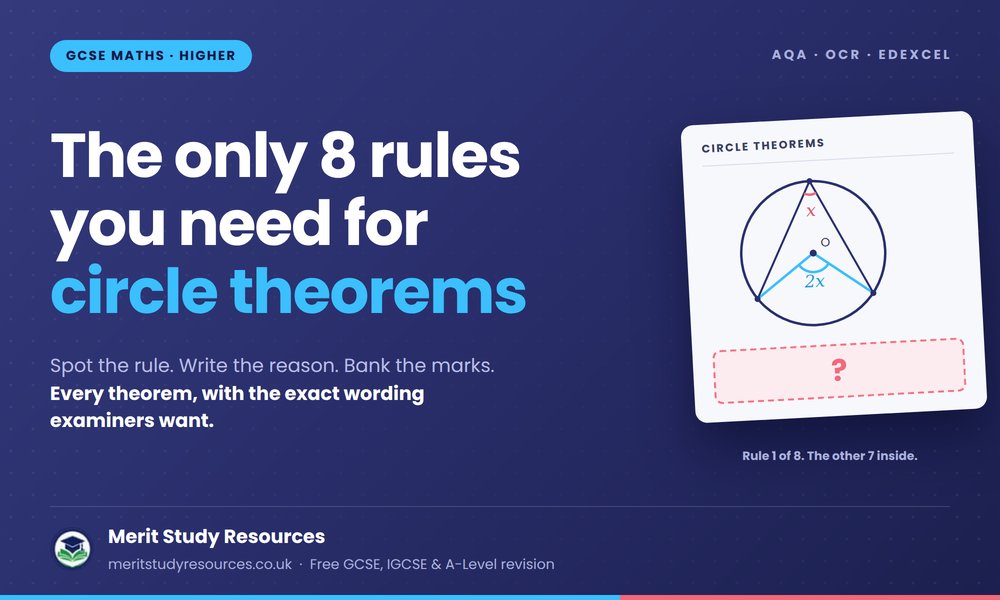
The angle at the centre is twice the angle at the circumference.
-
The angle in a semicircle is 90°.
-
Angles in the same segment are equal.
-
Opposite angles in a cyclic quadrilateral add up to 180°.
-
A tangent meets a radius at 90°.
-
Two tangents from the same external point are equal in length.
-
The perpendicular from the centre to a chord bisects the chord.
-
The alternate segment theorem: the angle between a tangent and a chord equals the angle in the alternate segment.
What are circle theorems?
Circle theorems are rules about the angles and lines you get when you draw chords, radii and tangents in a circle. In GCSE Maths they are Higher tier only: the national curriculum asks Higher students to "apply and prove the standard circle theorems concerning angles, radii, tangents and chords". Foundation students only need the circle vocabulary below.
Circle vocabulary you need first
You can't use the theorems if you can't name the parts of a circle. Learn these words:
|
Word
|
Meaning
|
|
Radius
|
A line from the centre to the edge of the circle
|
|
Diameter
|
A chord that passes through the centre (two radii)
|
|
Chord
|
A straight line joining two points on the circle
|
|
Tangent
|
A straight line that touches the circle at exactly one point
|
|
Arc
|
Part of the circumference
|
|
Sector
|
A "pizza slice" between two radii and an arc
|
|
Segment
|
The region between a chord and an arc
|
|
Cyclic quadrilateral
|
A four-sided shape with all four corners on the circle
|
Top tip: any two radii of the same circle are equal, so a triangle made from two radii and a chord is always isosceles. Spotting this unlocks a huge number of circle theorem questions.
The 8 circle theorems explained
1. The angle at the centre is twice the angle at the circumference
If two lines from the ends of an arc meet at the centre, and two more meet at the circumference, the angle at the centre is double the angle at the circumference.
Look for: an "arrowhead" or "V" shape, with one angle at the centre O and one on the edge, both standing on the same arc.
Example: the angle at the circumference is 38°. The angle at the centre is 2 × 38 = 76°.
2. The angle in a semicircle is 90°
If a triangle is drawn inside a circle with one side as the diameter, the angle opposite the diameter is always a right angle. This is really theorem 1 in disguise: the angle at the centre is 180°, so the angle at the circumference is 90°.
Look for: a triangle with one side passing through the centre.
Example: in triangle ABC, AB is a diameter and angle CAB = 27°. Angle ACB = 90°, so angle ABC = 180 − 90 − 27 = 63°.
3. Angles in the same segment are equal
Angles at the circumference that stand on the same chord (and are on the same side of it) are equal.
Look for: a "bow tie" or "butterfly" shape made by two triangles sharing the same chord.
Example: angle ADB = 41°. Angle ACB stands on the same chord AB in the same segment, so angle ACB = 41°.
4. Opposite angles in a cyclic quadrilateral add up to 180°
If all four corners of a quadrilateral lie on the circle, each pair of opposite angles adds up to 180°.
Look for: a four-sided shape with every corner touching the circle. Check all four corners. If one corner is at the centre, it isn't a cyclic quadrilateral.
Example: in cyclic quadrilateral ABCD, angle A = 112°. Angle C = 180 − 112 = 68°.
5. A tangent meets a radius at 90°
A tangent is perpendicular to the radius at the point where it touches the circle.
Look for: a straight line touching the outside of the circle, with a radius drawn to the same point.
Example: a tangent touches the circle at P, and it meets a line from the centre O at T. Angle OTP = 34°. Angle OPT = 90°, so angle POT = 180 − 90 − 34 = 56°.
6. Two tangents from the same point are equal in length
If two tangents are drawn to a circle from the same point outside it, they are the same length. This makes the triangle between them isosceles, and the line from the centre to that point cuts the "kite" shape in half.
Look for: a kite shape made from two tangents and two radii.
Example: tangents TA and TB meet at T, and angle ATB = 50°. Triangle TAB is isosceles, so angles TAB and TBA are each (180 − 50) ÷ 2 = 65°.
7. The perpendicular from the centre to a chord bisects the chord
A line from the centre that meets a chord at 90° cuts the chord exactly in half. The reverse is also true: a line from the centre to the midpoint of a chord meets it at 90°.
Look for: a chord with a line from the centre meeting it at a right angle. These questions often lead to Pythagoras.
Example: a circle has radius 10 cm and a chord 16 cm long. Half the chord is 8 cm, so the distance from the centre to the chord is √(10² − 8²) = √36 = 6 cm.
8. The alternate segment theorem
The angle between a tangent and a chord is equal to the angle in the alternate segment, which is the angle at the circumference on the other side of the chord.
Look for: a tangent, a chord from the point of contact, and a triangle drawn inside the circle. This is the theorem students forget most often.
Example: the angle between the tangent and chord AB is 64°. The angle ACB in the alternate segment is also 64°.
Circle theorems summary: the reasons to write in the exam
Most circle theorem questions say "give reasons for your answer". You only get the reasoning marks if you name the theorem clearly. Copy this wording:
|
Theorem
|
Reason to write
|
|
1
|
The angle at the centre is twice the angle at the circumference
|
|
2
|
The angle in a semicircle is 90°
|
|
3
|
Angles in the same segment are equal
|
|
4
|
Opposite angles in a cyclic quadrilateral add up to 180°
|
|
5
|
A tangent and a radius meet at 90°
|
|
6
|
Tangents from an external point are equal in length
|
|
7
|
The perpendicular from the centre to a chord bisects the chord
|
|
8
|
Alternate segment theorem
|
You'll often need basic angle facts too, so learn these reasons as well: angles in a triangle add up to 180°, angles on a straight line add up to 180°, angles around a point add up to 360°, and base angles of an isosceles triangle are equal.
Worked exam-style questions
Real exam questions usually need two or three theorems at once. Here's how to set out your working.
Question 1: centre angle and cyclic quadrilateral
A, B, C and D are points on a circle with centre O. Angle AOC = 140°. B is on the major arc and D is on the minor arc. Find angle ABC and angle ADC. Give reasons.
-
Angle ABC = 140 ÷ 2 = 70°. The angle at the centre is twice the angle at the circumference.
-
ABCD is a cyclic quadrilateral, so angle ADC = 180 − 70 = 110°. Opposite angles in a cyclic quadrilateral add up to 180°.
Question 2: two tangents
TA and TB are tangents to a circle with centre O, touching it at A and B. Angle ATB = 50°. Find angle AOB.
-
Angle OAT = angle OBT = 90°. A tangent and a radius meet at 90°.
-
OATB is a quadrilateral, so its angles add up to 360°.
-
Angle AOB = 360 − 90 − 90 − 50 = 130°. Angles in a quadrilateral add up to 360°.
Extension: if C is a point on the major arc, angle ACB = 130 ÷ 2 = 65°, using theorem 1.
Question 3: the alternate segment theorem
A tangent touches a circle at A. Triangle ABC is drawn inside the circle. The angle between the tangent and AB is 58°, and the angle between the tangent and AC is 72° (on the other side). Find all three angles of triangle ABC.
-
Angle ACB = 58°. Alternate segment theorem.
-
Angle ABC = 72°. Alternate segment theorem.
-
Angle BAC = 180 − 58 − 72 = 50°. Angles in a triangle add up to 180°.
Check: at point A, 58 + 50 + 72 = 180°, which matches angles on a straight line along the tangent.
Exam tips and common mistakes
-
Always write a reason for every step. A correct angle with no reason often only gets 1 mark out of 3.
-
Mark every angle you find on the diagram. New angles often unlock the next step.
-
Look for radii first. Two radii make an isosceles triangle, which is the hidden step in many questions.
-
Check a quadrilateral is really cyclic. All four corners must be on the circle. A shape with a corner at the centre is not a cyclic quadrilateral.
-
Don't assume the diagram is accurate. Exam diagrams say "not drawn accurately", so never measure angles.
-
Don't mix up "centre" and "circumference". The angle at the centre is the bigger one, twice the angle at the edge.
-
Remember the alternate segment theorem. If a question has a tangent and a triangle inside the circle, it is almost always needed.
Want to get into the habit of writing full reasons? Our guide to using GCSE Maths past papers and mark schemes shows how examiners award method and reasoning marks.
Frequently asked questions
How many circle theorems are there?
There are 8 main circle theorems at GCSE. Some textbooks split or combine them differently, so you may see lists of 7 or 9, but the rules are the same.
Are circle theorems on the Foundation paper?
No. Circle theorems are Higher tier only. Foundation students need to know the parts of a circle, such as radius, chord, tangent, arc, sector and segment.
Are circle theorems on the calculator or non-calculator paper?
They can appear on any paper. The angle work rarely needs a calculator, but chord questions using Pythagoras may.
Do you need to prove circle theorems?
Yes, sometimes. The Higher specification includes proving circle theorems, so you might be asked to show why the angle at the centre is twice the angle at the circumference. Split the diagram into isosceles triangles using radii and use angle facts.
Are circle theorems in A Level Maths?
A Level Maths builds on them in coordinate geometry, for example using "the angle in a semicircle is 90°" or "a tangent is perpendicular to the radius" to find equations of circles and tangents.
Practise circle theorems with free past papers
The fastest way to master circle theorems is to practise real exam questions. Download free papers and mark schemes from Merit Study Resources:
For a full revision plan, read how to get a grade 9 in GCSE Maths, revise GCSE Maths past papers by topic, and use our GCSE Maths revision worksheets with answers.
Sources
Ready to try it? Every paper in the library comes with its mark scheme and a
worked solution, so you can practise without hunting for files.
Find past papers