SOHCAHTOA only works for right-angled triangles. For every other triangle, you need the sine rule and the cosine rule. They come up on almost every GCSE Maths Higher paper, and the hardest part isn't the formula. It's knowing which rule to use.
This guide gives you both formulas, a simple test for choosing the right one, and fully worked examples you can follow step by step.
Quick answer
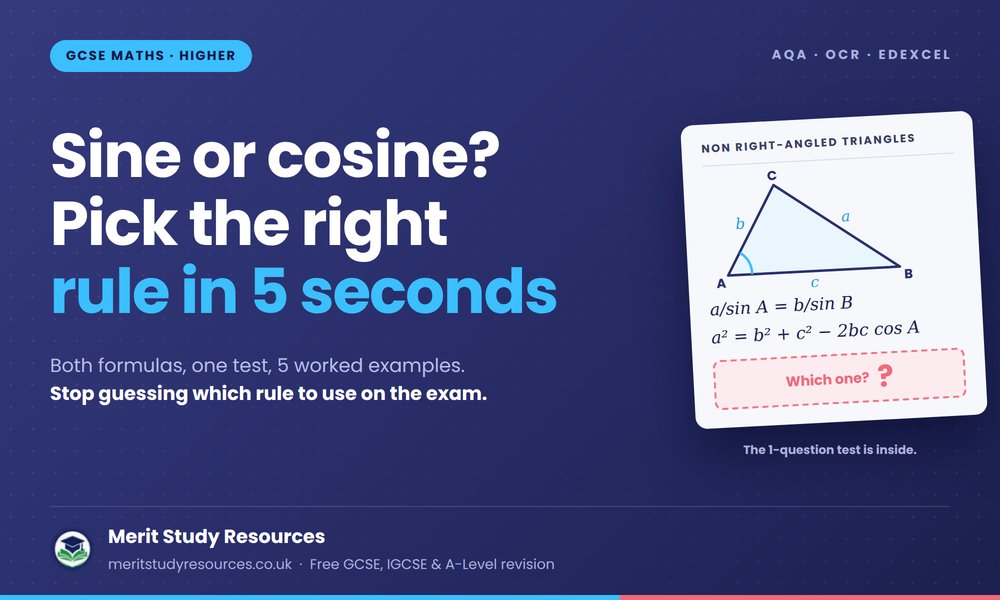
• Sine rule: a / sin A = b / sin B = c / sin C. Use it when you know a side and the angle opposite it.
• Cosine rule: a² = b² + c² − 2bc cos A. Use it when you know two sides and the angle between them, or all three sides.
• Area of any triangle: Area = ½ ab sin C.
First: how to label a triangle
Both rules depend on labelling the triangle correctly. Get this right and the rest is just substitution.
• Label the three angles with capital letters: A, B and C.
• Label each side with the lower-case letter of the angle opposite it. Side a is opposite angle A, side b is opposite angle B, and side c is opposite angle C.
So a side and its angle always share the same letter and sit on opposite sides of the triangle. This "opposite pair" is the key to choosing between the two rules.
Top tip: you don't have to use the letters in the question. Relabel the triangle so the angle you want is A, then the formulas below work as written.
The sine rule
The sine rule links each side of a triangle to the sine of the angle opposite it.
To find a side: a / sin A = b / sin B = c / sin C
To find an angle: sin A / a = sin B / b = sin C / c
Both versions say the same thing. Flipping it upside down just puts the unknown on top, which makes the algebra easier.
When to use the sine rule
Use the sine rule when you know one complete opposite pair (a side and the angle opposite it), plus one more side or angle. You only ever need two parts of the formula at once.
Example 1: finding a side
In triangle ABC, angle A = 40°, angle B = 65° and side a = 8 cm. Find side b.
1. You know the pair a and A, and you want b, which is opposite B. Use the sine rule.
2. Write it out: b / sin 65° = 8 / sin 40°
3. Multiply both sides by sin 65°: b = 8 × sin 65° ÷ sin 40°
4. b = 11.3 cm (to 1 decimal place)
Example 2: finding an angle
In triangle ABC, side a = 9 cm, side b = 7 cm and angle A = 70°. Find angle B.
1. You know the pair a and A, and you want B. Use the "angles on top" version.
2. sin B / 7 = sin 70° / 9
3. sin B = 7 × sin 70° ÷ 9 = 0.7309…
4. B = sin⁻¹(0.7309…) = 47.0° (to 1 decimal place)
Keep the full number in your calculator between steps. Rounding too early is one of the most common ways to lose the accuracy mark.
The ambiguous case (Higher)
When you use the sine rule to find an angle, there can sometimes be two possible answers: an acute angle x and an obtuse angle 180° − x. Your calculator only gives the acute one. At GCSE the question will usually tell you if the angle is obtuse, so check the diagram and the wording.
The cosine rule
The cosine rule is like Pythagoras' theorem with an extra term that corrects for the angle not being 90°.
To find a side: a² = b² + c² − 2bc cos A
To find an angle: cos A = (b² + c² − a²) / 2bc
In both versions, a is the side opposite angle A. The other two sides, b and c, are the ones either side of A.
When to use the cosine rule
Use the cosine rule when you don't have an opposite pair:
• you know two sides and the angle between them, and want the third side
• you know all three sides, and want an angle
Example 3: finding a side
In triangle ABC, b = 6 cm, c = 9 cm and the angle between them, A = 50°. Find side a.
1. Two sides and the angle between them, so use the cosine rule.
2. a² = 6² + 9² − 2 × 6 × 9 × cos 50°
3. a² = 36 + 81 − 108 cos 50° = 47.578…
4. a = √47.578… = 6.90 cm (to 3 significant figures)
Watch out: work out 2bc cos A as one term and subtract it. A common mistake is to calculate (36 + 81 − 108) first and then multiply by cos 50°.
Example 4: finding an angle
A triangle has sides 7 cm, 8 cm and 10 cm. Find the largest angle.
1. The largest angle is opposite the longest side (10 cm). Call it angle A, so a = 10, b = 7 and c = 8.
2. cos A = (7² + 8² − 10²) / (2 × 7 × 8)
3. cos A = (49 + 64 − 100) / 112 = 13 / 112 = 0.1160…
4. A = cos⁻¹(0.1160…) = 83.3° (to 1 decimal place)
If cos A comes out negative, the angle is obtuse. That's fine: your calculator will give an answer between 90° and 180°.
Area of a triangle using sine
When you don't know the perpendicular height, use this formula instead of ½ × base × height:
Area = ½ ab sin C
Here, a and b are two sides and C is the angle between them.
Example 5
Two sides of a triangle are 8 cm and 11 cm, and the angle between them is 35°. Find the area.
1. Area = ½ × 8 × 11 × sin 35°
2. Area = 44 × sin 35°
3. Area = 25.2 cm² (to 3 significant figures)
This formula often appears in the last step of a longer question. You may need the sine or cosine rule first to find a missing angle, then use ½ ab sin C for the area.
Sine rule or cosine rule? How to decide
Ask yourself one question: do I know a side and the angle opposite it?
• Yes → use the sine rule.
• No → use the cosine rule.
And if the triangle has a right angle, you don't need either. Use SOHCAHTOA or Pythagoras.
|
What you know
|
What you want
|
Use
|
|
Two angles and one side
|
A side
|
Sine rule
|
|
Two sides and an angle opposite one of them
|
An angle
|
Sine rule
|
|
Two sides and the angle between them
|
The third side
|
Cosine rule
|
|
All three sides
|
An angle
|
Cosine rule
|
|
Two sides and the angle between them
|
The area
|
½ ab sin C
|
|
A right-angled triangle
|
A side or angle
|
SOHCAHTOA or Pythagoras
|
Top tip: if you know two angles, you know all three. Angles in a triangle add up to 180°, so you can always find an opposite pair and use the sine rule.
Exam tips and common mistakes
• Check your calculator is in degrees. If it's in radians, every answer will be wrong. Look for a small "D" on the screen.
• Label the triangle before you start. Most mistakes come from putting the right number in the wrong place.
• Don't round too early. Use the ANS button or keep the full value, and only round your final answer.
• Use brackets on your calculator. Type the cosine rule as 36 + 81 − (108 × cos 50), or you may get a different answer.
• Remember the square root. The cosine rule gives a², not a.
• Sense-check your answer. The longest side is always opposite the largest angle, and the shortest side is opposite the smallest angle.
Is the sine and cosine rule on the formula sheet?
For the 2025, 2026 and 2027 GCSE exams, Ofqual lets students use a formulae sheet in GCSE Maths. The Higher tier sheet includes the sine rule, the cosine rule and Area = ½ ab sin C. The Foundation sheet doesn't, because these topics are Higher only. Knowing the formula isn't enough, though. The marks come from choosing the right rule and substituting correctly. Read our guide to GCSE and A Level formula sheets for what's given in each subject.
Frequently asked questions
What is the difference between the sine rule and the cosine rule?
The sine rule uses pairs of opposite sides and angles, so you need one complete pair to use it. The cosine rule works without an opposite pair: use it when you know two sides and the angle between them, or all three sides.
Can you use the sine rule on a right-angled triangle?
Yes, it still works, because sin 90° = 1. But SOHCAHTOA is quicker, so use that for right-angled triangles.
Is the cosine rule just Pythagoras?
Almost. When the angle is 90°, cos 90° = 0, so the last term disappears and you're left with a² = b² + c², which is Pythagoras' theorem.
Are the sine and cosine rules on the Foundation paper?
No. At GCSE they are Higher tier only.
Do you use the sine and cosine rule in A Level Maths?
Yes. A Level Maths uses both rules, often with angles in radians, and in mechanics questions involving forces and vectors.
Practise with free past papers
The best way to get confident is to try real exam questions. Download free GCSE Maths past papers and mark schemes from Merit Study Resources:
• AQA GCSE Maths past papers
• Edexcel GCSE Maths past papers
• OCR GCSE Maths past papers
• Edexcel IGCSE Maths A past papers
Keep going with our guides to circle theorems, how to get a grade 9 in GCSE Maths and GCSE Maths past papers by topic.
Ready to try it? Every paper in the library comes with its mark scheme and a
worked solution, so you can practise without hunting for files.
Find past papers